The Oilseed Corridor: Can Nampula Help Fill India's Cooking-Oil Gap?
On 2 October India's oil industry and the governor of Nampula signed up to explore an oilseed corridor through Nacala. India imports 16 million tonnes of vegetable oil a year; Mozambique sends it almost none. We run the numbers on what the deal could — and could not — achieve.
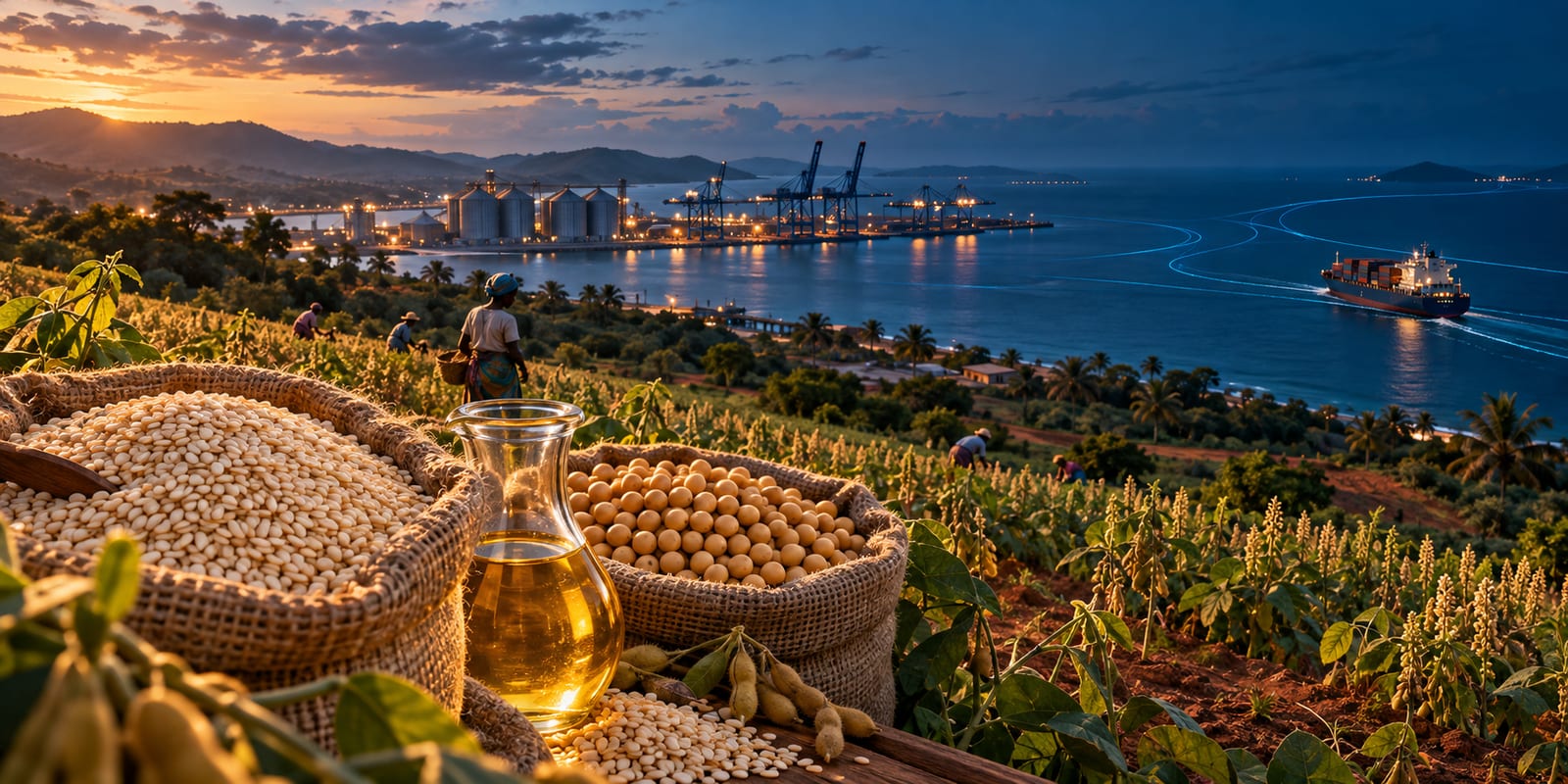
A Mumbai handshake with a Nampula horizon
On 2 October 2026, on the sidelines of the Globoil India conference in Mumbai, the Solvent Extractors' Association of India (SEA) — the trade body of the companies that crush, refine and import most of India's cooking oil — signed a three-year Statement of Interest with the Government of Nampula Province. The goal: to study a sustainable oilseed and vegetable oil corridor running from the farms of northern Mozambique to the Port of Nacala and on to India.
The two sides are almost perfectly mismatched in size. India is the world's largest vegetable oil importer. Mozambique, despite millions of hectares of suitable land, sells India practically no oilseeds — and imports much of its own cooking oil. This article explains what was signed, why India is looking to Africa, what Mozambique actually grows today, and — using an interactive calculator — how big the corridor would need to be to matter to either country.
For India, a Nampula corridor is a hedge. For Mozambique, it could be an industry.
An exploratory deal, deliberately small
The agreement is a Statement of Interest, not a purchase contract. It commits no volumes and no money. What it creates is a process: a Joint Working Group, with each side nominating representatives within 15 days, to run feasibility studies on soil, transport, port capacity, market costs and environmental impact. An SEA member delegation is scheduled to visit Nampula in the first quarter of 2027 to inspect farmland, infrastructure and the Port of Nacala.
The signatories matter. SEA was represented by its president, Angshu Mallick, who is also executive deputy chairman of AWL Agri Business — one of India's largest edible oil companies. Nampula was represented by Governor Eduardo Mariamo Abdula. The development organisation Solidaridad, through its Asia and Southern Africa arms, joined as sustainability partner — a sign that both sides know land is the most sensitive word in this story.
India's 16-million-tonne habit
India eats far more vegetable oil than it grows. In the 2024-25 oil year it imported more than 16 million tonnes, worth over ₹1.8 lakh crore (roughly $21bn), covering about 60% of domestic consumption. Almost all of it comes from a handful of countries: palm oil from Indonesia and Malaysia, soybean oil from Argentina and Brazil, and sunflower oil from Russia and Ukraine.
The mix is shifting. Palm oil, long the cheapest option, fell to about 7.6 million tonnes in 2024-25 while soybean oil climbed to a record 5.5 million tonnes. Each of those supply lines has a single point of failure — an Indonesian export levy, a Black Sea war, a drought in Argentina — and SEA projects national demand rising to 46.5 million tonnes by 2047.
Self-reliance at home, diversification abroad
New Delhi's main answer is domestic. The National Mission on Edible Oils – Oilseeds, approved in October 2024 with an outlay of ₹10,103 crore for 2024-25 to 2030-31, aims to raise primary oilseed output from 39 million tonnes to 69.7 million tonnes and domestic edible oil from 12.7 million to 20.2 million tonnes — cutting import dependence from about 57% to roughly 28%.
Even if the mission hits every target, India will still need to import millions of tonnes of oil a year, and demand keeps growing. That is the opening for diversification: new origins such as East Africa, closer to India's west-coast refineries than Latin America and politically friendlier than many alternatives. Nampula is the first Mozambican province to sign up formally.
What Mozambique grows — and who buys it
Mozambique is already a significant oilseed producer, just not for India. The Cotton and Oilseeds Institute (IAOM) puts sesame output at about 200,000 tonnes a year, among the eight largest in the world; Sofala alone grows about a quarter of it. Total oilseed production was estimated at around 400,000 tonnes a year in 2022. Groundnut is grown by smallholders across the country, but at very low yields — about 355 kg per hectare in the last detailed FAO estimate, against more than 4,000 kg in the United States.
The buyer is China. Mozambique's oilseed exports to China were worth about $201m in 2024, mostly sesame. India, by contrast, imported only about $0.28m of Mozambican oilseeds in 2025. In other words, the corridor starts from almost zero.
There is a domestic twist too. Mozambique's refineries imported more than 1.3 million tonnes of crude cooking oil between 2015 and 2023, worth about $1.4bn — roughly 144,000 tonnes a year. Cooking oil imports cost around $320m in 2021 alone. Any oil crushed in Nampula has a hungry home market before it ever reaches India.
How big would the corridor need to be?
Scale is the crux. Even if every kilogram of Mozambique's current oilseed crop were crushed and shipped to India, it would yield roughly 160,000 tonnes of oil — about 1% of India's annual imports. The country's entire sesame crop would cover about 0.6%.
That does not make the corridor pointless; it changes who it matters to. A programme that put 100,000 hectares of groundnut under improved seed and practices — raising yields from about 0.36 to 1.5 tonnes a hectare — would produce around 67,500 tonnes of oil. That is a rounding error for India but nearly half of Mozambique's own yearly crude oil imports. Only oil palm, which yields several tonnes of oil per hectare, could move India's numbers — and it is barely planted in Mozambique today.
Use the calculator to test your own assumptions: choose an area, a yield and an oil content, and decide how much of the oil stays in Mozambique.
The route: Nampula, the Nacala corridor and the port
Nampula's advantage is geography. The province sits on the Nacala Development Corridor, with road and rail links running east to the Port of Nacala — Mozambique's deepest natural harbour — and west through Cuamba towards Malawi. Mozambique's soybean heartland around Gurué in Zambézia and the farmland of Niassa feed into the same network.
The port is growing. Nacala handled about 1.4 million tonnes in 2024, up from 1.3 million, passing 100,000 containers for the first time after its terminal upgrade, and expected about 1.8 million tonnes in 2025. Sesame is already one of its main exports. The question for the Joint Working Group is whether rural roads, storage and crushing capacity can keep up — not the quay itself.
Land, lessons and the ProSAVANA shadow
The Nacala corridor has been here before. ProSAVANA, a Japanese-led agricultural development programme for the same region, faced resistance from peasant movements from 2012, lost a court case in 2018 and was formally terminated in July 2020 without completing its master plan. Farmers feared that large-scale commercial agriculture would push them off land they hold under customary rights.
The SEA–Nampula document appears written with that history in mind. Its safeguards promise smallholder empowerment, protection of land rights, careful water management and expansion only onto degraded or already converted land. Those are the right words; the test will be whether the feasibility studies are public and whether farmer organisations sit on the Joint Working Group.
Five things that would make the corridor real
Crush in Nampula, not Mumbai
Exporting oil and oilcake rather than raw seed keeps value, jobs and poultry feed in Mozambique, and cuts the country's own import bill first.Outgrowers, not plantations
Contract farming with seed, credit and a guaranteed buyer — the model behind cotton and tobacco — avoids the land conflicts that sank ProSAVANA.Fix yields before acreage
Groundnut at 0.36 t/ha is a seed and extension problem. Doubling yields on existing farms beats clearing new land.Learn from pigeon peas
India's tur dal deal shows the risk of a single buyer. Selling oil both at home and to India — and cake to the region — spreads the risk.Use the sesame base
Sesame already has traders, a 50,000-tonne processing plant at Dondo and a working export channel through Nacala. It is the quickest proof of concept.What to watch
- Jul 2020ProSAVANA formally terminated after years of opposition in the Nacala corridor.
- Oct 2024India approves the ₹10,103-crore National Mission on Edible Oils – Oilseeds.
- May 2026President Chapo attends the India–Africa Forum Summit in New Delhi.
- 2 Oct 2026SEA and the Government of Nampula sign a three-year Statement of Interest at Globoil India, Mumbai.
- Oct 2026Joint Working Group members due within 15 days of signing.
- Q1 2027SEA member delegation visits Nampula farmland, infrastructure and the Port of Nacala.
- 2027–2029Feasibility studies, pilot sourcing and any crushing investment decisions inside the three-year window.
The deal is small on paper and large in possibility. If it ends with an Indian-backed crushing plant in Nampula, outgrower schemes that raise smallholder yields, and oil sold both in Maputo and Mumbai, it will have done something the pigeon-pea trade never did: keep more of the value in Mozambique. If it ends with raw seed on ships and disputes over land, it will join a long list of corridor promises.
Sources
This report draws on 15 cited sources. View them in Sources cited in every report →
Related insights
 Report
The Quiet Majority: Why Mozambique's Small Firms, Not Its Megaprojects, Will Decide Its Jobs Future
New FinScope data show Mozambique's micro, small and medium enterprises involve 9.3 million people and turn over about 341 billion meticais a month. A critical reading of the numbers — and of a growth model that has bet on megaprojects that employ thousands while small firms carry millions.
 Report
AI Without Industrialisation: Can Africa Leapfrog the Traditional Development Model?
Artificial intelligence promises productivity without factories. We built an original model of job exposure across banking, education, retail, logistics and public administration in Mozambique — and found that the binding constraint is not the algorithm, but electricity, connectivity and paper.
 Report
What It Really Costs: Doing Business in Maputo vs. Dar es Salaam, Johannesburg and Lusaka
Cheap electricity and competitive fuel — but the highest corporate tax rate, 15.5% loans and a dollar shortage. A side-by-side look at the costs that decide where investors in southern and eastern Africa put their money.