The Quiet Majority: Why Mozambique's Small Firms, Not Its Megaprojects, Will Decide Its Jobs Future
New FinScope data show Mozambique's micro, small and medium enterprises involve 9.3 million people and turn over about 341 billion meticais a month. A critical reading of the numbers — and of a growth model that has bet on megaprojects that employ thousands while small firms carry millions.
Nine million people and a blind spot
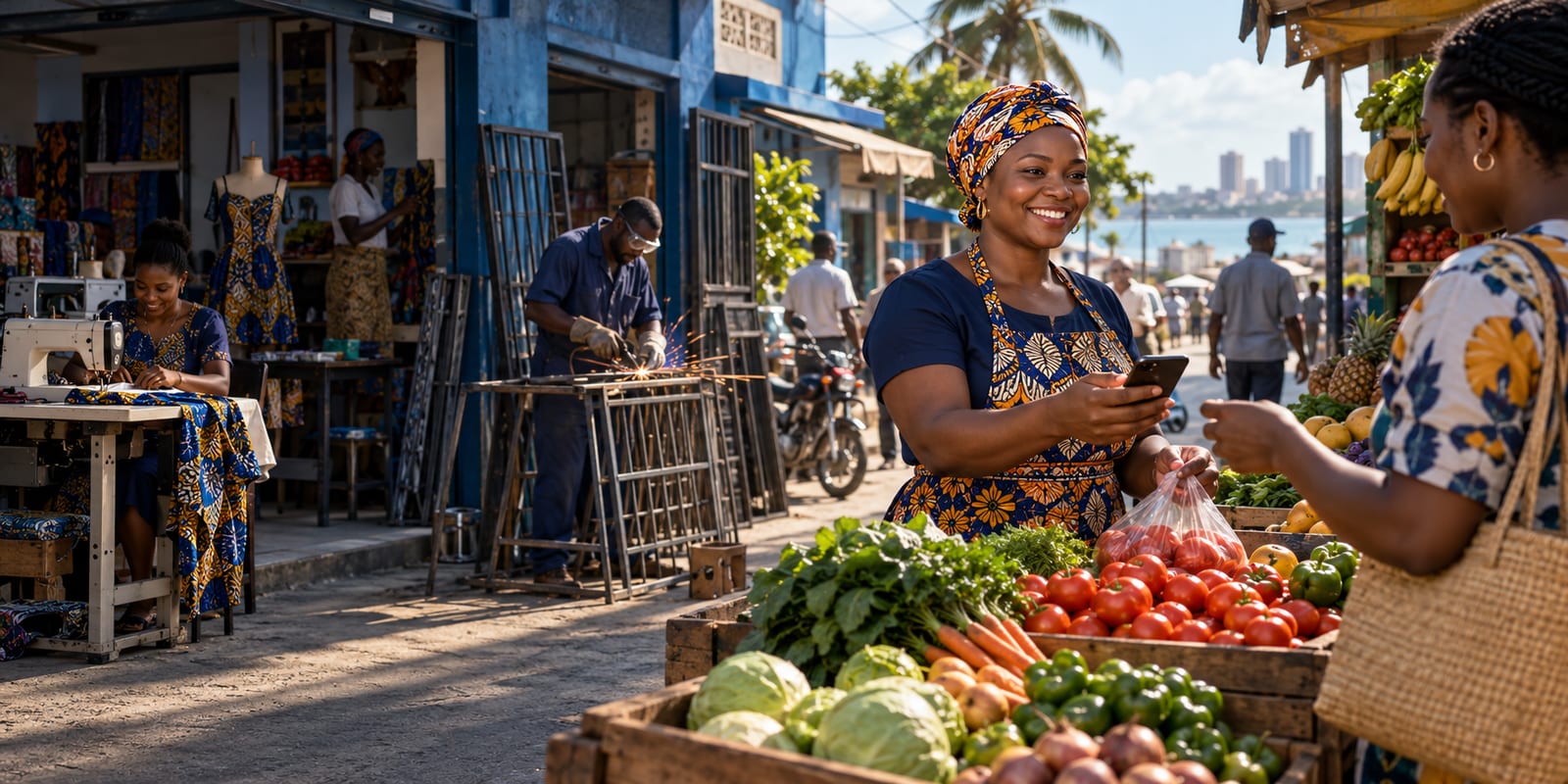
For two decades, Mozambique's economic story has been told through its megaprojects: an aluminium smelter, coal in Tete, gas in the Rovuma basin. The country's actual working life has been taking place somewhere else — at market stalls, tailoring benches, welding yards, roadside kitchens and repair shops. New data now put a number on it.
The FinScope MSME 2025 survey, presented by the Council of Ministers on 27 October, finds that MSMEs involve about 9.3 million people and contribute some 64.6 billion meticais a month to the economy. This article reads those figures critically, sets them against the megaproject model, compares Mozambique with India and Kenya, and does the jobs arithmetic for a country where around half a million young people look for work every year.
Megaprojects decide Mozambique's export earnings. Small firms decide whether Mozambicans have work.
What the new figures say — and what they do not
Three numbers dominate the coverage: 9.3 million people, a business volume of 341.4 billion meticais a month (the figure reported as €4.7 billion), and a contribution of 64.6 billion meticais a month. They measure different things, and the distinction matters.
Business volume is not output. 341 billion meticais a month is gross sales — a trader who buys tomatoes for 80 and sells them for 100 contributes 100 to turnover but only 20 to value added. The 64.6 billion figure is the closer measure of what MSMEs add to the economy. Annualised, it is about 775 billion meticais, or roughly $12.1 billion — equivalent to around 51% of the IMF's estimate of Mozambique's 2025 GDP. Reporting has not always been consistent: one wire account described 341.4 billion meticais as annual production, which cannot be reconciled with the monthly figures elsewhere.
"People involved" is not "jobs". The 9.3 million includes owners, family helpers and part-time workers, many of whom also farm. Divided across 9.3 million people, the monthly value added is about 6,946 meticais — roughly $109 — per person. That is the core of the story: MSMEs are where Mozambicans work, but at very low productivity.
Survey, not census. FinScope is a household-based survey of self-reported activity. The separate INE business census (CEMPRE 2025–26), which counts registered entities, found 121,713 active companies and establishments employing just over a million people. The gap between 9.3 million and 1 million is, in effect, the size of Mozambique's informal enterprise economy.
Two economies: one earns the dollars, the other employs the people
Development economists call it dualism: a capital-intensive modern sector that generates exports and tax but few jobs, alongside a vast low-productivity sector that employs almost everyone. Mozambique is a textbook case.
Consider the scale. The $20 billion Mozambique LNG project, now about 45% complete, had between 7,000 and 8,000 people building it in mid-2026 — roughly $2.5 million of capital per construction job, and far fewer permanent jobs once it operates. The Mozal aluminium smelter, for 25 years the flagship of Mozambique's industrialisation, went into care and maintenance in March 2026 after failing to secure affordable power; more than 4,000 direct and indirect jobs were at risk, equivalent to a third of the country's manufacturing employment. By contrast, FinScope's 9.3 million people in MSMEs is more than a thousand times Mozambique LNG's construction workforce.
None of this makes megaprojects a mistake. They earn foreign exchange, fund the budget and, when linked to local suppliers, create demand for small firms. But they cannot be a jobs strategy. Mozal's closure is the cautionary tale: a single power contract decided the fate of a third of manufacturing jobs.
Big projects hire skills; small firms absorb people
The deeper reason megaprojects create so few Mozambican jobs is skills. LNG trains, smelters and mines need certified welders, instrument technicians, engineers and safety specialists — skills the domestic education system produces in small numbers, so they are often filled by expatriates or by a thin layer of experienced nationals. Their demand for unskilled labour peaks during construction and then falls away.
MSMEs work the other way round. A market stall, a tailoring business or a welding yard has almost no entry barrier: skills are learnt on the job, often through informal apprenticeships, and capital is measured in hundreds of dollars, not millions. That is why they absorb school leavers, women balancing care work, and rural migrants arriving in Maputo, Beira and Nampula. The price is low productivity and insecurity.
A healthy economy needs both ends of the ladder — and, crucially, the middle rungs, where a small firm grows into a medium one, takes on apprentices, buys equipment and starts selling to bigger companies. That middle is where Mozambique is weakest.
The missing middle
INE's 2025 business statistics show the shape of the formal sector. Of 93,612 active companies, 65.7% are micro, 28.8% small, 2.2% medium and 1.3% large. Micro firms account for 31.7% of formal employment and large firms for 28.3%. The CEMPRE census adds two more signals: 54.3% of entities are in wholesale and retail trade, and Maputo City alone holds 28.8% of entities and 36.2% of employment — with roughly 70% of large companies in Maputo City and Province combined.
The picture is a sector dominated by trading micro-firms concentrated in the capital, with very few firms in the 'missing middle' of medium-sized manufacturers and service providers that, in East Asia, did most of the job creation. Moving firms from micro to small, and from small to medium, is the single most powerful lever Mozambique has for productivity.
A women's and young people's economy
FinScope 2025 finds women own 56% of MSMEs, up from 40% in 2012, and people under 35 own 45%, with about 15% of owners under 25. Small enterprise is the main route into economic life for women and young Mozambicans.
Aspirations point the same way. In an Afrobarometer survey published in June 2026, 46% of young respondents said they would prefer to start their own business, against 31% who preferred a public-sector job — while 65% of 18-to-35-year-olds said they had looked for work without success in 2025. Entrepreneurship is not only a fallback; for many young Mozambicans it is the plan.
The cost of money
Ask a Mozambican small-business owner what holds them back and the answer is usually credit. The numbers bear it out. Bank credit to the private sector was 17.7% of GDP in 2025, against a world average of about 47.5%. The prime rate stood at 15.50% in October 2026, built on the Banco de Moçambique's 9.30% reference index. Banks add a risk spread that averaged about 4.3 percentage points across published categories; microfinance institutions, which serve the smallest firms, published consumer-loan spreads averaging about 28 points.
In practice that means a formal small firm borrows at around 20% and a micro-entrepreneur through microfinance at 40% or more — in a country where, by our estimate, the average MSME participant adds about $109 of value a month. Globally, the IFC estimates the unmet financing need of formal MSMEs in developing countries at $5.2 trillion a year. FUNDEC's business indices for the first quarter of 2026 tell the same story locally, with its business and financial rating falling to 38.62 points as firms cited credit access and borrowing costs.
What India and Kenya teach
India is the clearest case of a large MSME sector deliberately linked to growth. According to the Ministry of MSME, MSMEs contribute about 30% of GDP and 45.7% of exports, with 6.53 crore (65.3 million) registered enterprises. The policy architecture behind that — simple online registration (Udyam), credit guarantees, priority-sector lending rules and preferential public procurement — turned informal firms into visible, bankable ones that could plug into export supply chains. The lesson for Mozambique is not the scale but the plumbing: registration that is free and fast, and credit that follows registration.
Kenya is the closer mirror. Its 2016 national MSME survey counted about 7.41 million MSMEs employing 14.9 million people, contributing roughly a third of GDP — but only 1.56 million were licensed. Africa Check has warned that inconsistent data make precise shares unreliable, a caution that applies equally to Mozambique. Kenya's distinctive asset was mobile money: M-Pesa transaction histories became the basis for digital credit to millions of micro-firms. Mozambique, with 24.6 million mobile wallet accounts, has the same raw material.
Both cases point to the same conclusion: MSMEs become a growth engine not when they are numerous — Mozambique already has that — but when they are visible to banks, connected to larger buyers and able to grow past the micro stage.
The jobs arithmetic: who will employ half a million people a year?
The World Bank and the Ministry of Youth estimate that 450,000 to 500,000 young Mozambicans enter the labour market every year. The government authorised only 4,142 new public-sector hires for 2025. Megaprojects add thousands, not hundreds of thousands. Formal companies, employing about a million people in total, would need extraordinary growth to absorb even a tenth of each cohort.
Whatever is left must be absorbed by MSMEs and family farms. Use the calculator to set your own assumptions: on our defaults, small firms must absorb more than nine in ten new entrants, which means their workforce must grow by about 5% a year — or roughly one MSME in fourteen adding a worker every year — just to keep pace.
Seven levers to lift the quiet majority
Make registration worth it
A free, phone-based registration that unlocks a bank account, a tax number and eligibility for public tenders — formalisation as a benefit, not a penalty.Credit on mobile-money data
Use wallet transaction histories and movable collateral (stock, equipment, receivables) to lend to firms with no title deeds.Partial credit guarantees
A state or donor guarantee covering half of a bank's loss on small-business loans cuts the risk spread that keeps rates near 20%.Link megaprojects to suppliers
Local-content rules that unbundle catering, transport, uniforms, maintenance and construction into contracts small firms can win.Reliable, affordable power
Mozal shows what power costs large firms; for a welder or a cold-room operator, outages are the same problem in miniature.Apprenticeships with certificates
Formalise the informal apprenticeships that already train most artisans, so skills become portable and bankable.Grow the middle
Target support at firms with 5–50 workers — the medium-sized manufacturers and service firms Mozambique conspicuously lacks.Reframing the growth model
The FinScope numbers should change how Mozambique talks about its economy. Megaprojects remain essential for foreign exchange and public revenue, and LNG will transform the balance of payments from 2029. But they will never employ more than a sliver of the workforce, and Mozal has shown how fragile even the largest of them can be.
The quiet majority — 9.3 million people, most of them women and young — is already Mozambique's real employer. Its weakness is not size but productivity: tiny firms, expensive credit, little access to big buyers and almost no path to becoming medium-sized. A growth strategy that put small-firm productivity at its centre, and used the megaprojects to buy from them, would be the most direct route to the jobs a young country needs.
- Mar 2026Mozal placed on care and maintenance; more than 4,000 jobs at risk.
- Aug 2026Mozambique LNG about 45% complete, 7,000–8,000 workers on site; first LNG targeted for 2029.
- Sep 2026Prime rate held at 15.50% for October.
- 27 Oct 2026Government presents FinScope MSME 2025 and CEMPRE 2025–26 results.
Sources
This report draws on 16 cited sources. View them in Sources cited in every report →
Related insights
 Report
AI Without Industrialisation: Can Africa Leapfrog the Traditional Development Model?
Artificial intelligence promises productivity without factories. We built an original model of job exposure across banking, education, retail, logistics and public administration in Mozambique — and found that the binding constraint is not the algorithm, but electricity, connectivity and paper.
 Report
The Oilseed Corridor: Can Nampula Help Fill India's Cooking-Oil Gap?
On 2 October India's oil industry and the governor of Nampula signed up to explore an oilseed corridor through Nacala. India imports 16 million tonnes of vegetable oil a year; Mozambique sends it almost none. We run the numbers on what the deal could — and could not — achieve.
 Report
What It Really Costs: Doing Business in Maputo vs. Dar es Salaam, Johannesburg and Lusaka
Cheap electricity and competitive fuel — but the highest corporate tax rate, 15.5% loans and a dollar shortage. A side-by-side look at the costs that decide where investors in southern and eastern Africa put their money.