Corridors of Power: How Maputo, Beira and Nacala Earn from Africa's Landlocked Heart
Six landlocked neighbours need the sea, and Mozambique has three ports to sell them. Record volumes at Maputo, a container boom at Beira and a coal railway at Nacala — and a new US-backed rival on Africa's other coast.
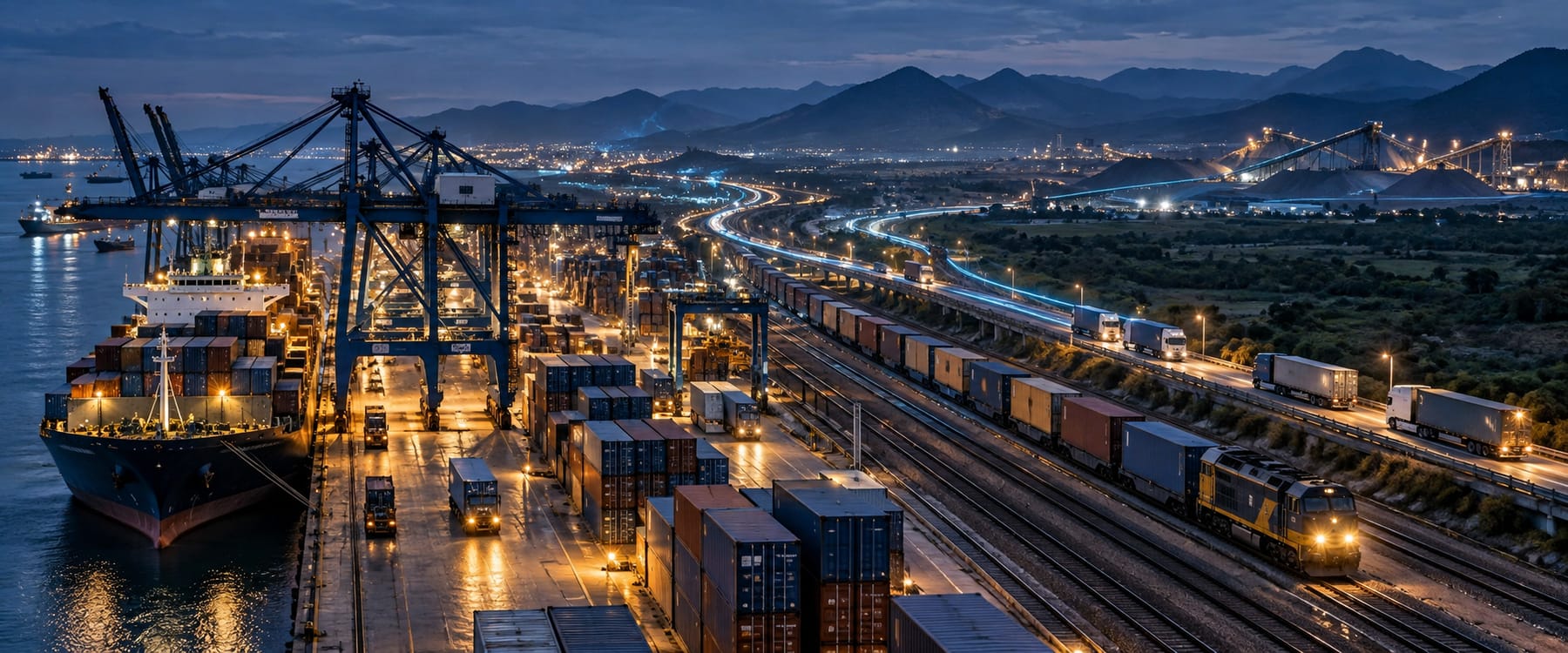
Geography as an export
Mozambique's most reliable export may be its coastline. Behind it lie Zimbabwe, Zambia, Malawi, Eswatini, Botswana and the mineral belt of South Africa's Mpumalanga and Limpopo provinces — economies that must cross Mozambican territory, or go much further, to reach the Indian Ocean.
Three ports, each anchoring a corridor, turn that geography into revenue: Maputo for South Africa and Eswatini, Beira for Zimbabwe, Zambia and Malawi, and Nacala for Malawi and the coal of Tete. This article compares them, explains who uses them, and sets out the competition they face.
Maputo: South Africa's other port
The Port of Maputo handled a record 32.0 million tonnes in 2025, up 3.4% from 30.9 million tonnes in 2024. Much of it is South African: chrome, coal, magnetite and ferro-alloys from the mines of Mpumalanga and Limpopo, which often find Maputo closer, cheaper or simply less congested than Richards Bay or Durban. The port's general manager has said it now handles around half of all chrome produced in South Africa — the world's largest producer.
The port is run by the Maputo Port Development Company (MPDC), a partnership between Mozambique's state railway company CFM, DP World and Grindrod. In 2024 the government extended the concession by 25 years to April 2058, in exchange for a $2bn investment programme, $600m of it in the first three years. Planned works take the bulk terminal to 16 million tonnes, DP World's container terminal to 530,000 TEU and the Grindrod magnetite and coal terminal to 12 million tonnes. The concession paid the state $48.9m in fees in 2025, excluding taxes and dividends.
The bottleneck is on land. Rail volumes reached 11.7 million tonnes in 2025, up from 9.7 million, but most cargo still arrives by truck, and queues at the Lebombo–Ressano Garcia border regularly stretch for kilometres. Doubling the Ressano Garcia rail line from 8 to 20 million tonnes of capacity is the single most important fix.
Beira: the container boom
Beira was ranked the most efficient container port in Southern Africa in the World Bank's 2023 Container Port Performance Index, and the numbers since have borne that out. The terminal operated by Cornelder de Moçambique handled 412,100 TEU in 2024, up from 327,300 in 2023 and nearly double the 2015 level. General cargo reached 4.05 million tonnes.
Zimbabwe is the largest user: tobacco exports through the corridor have risen above 300,000 tonnes a year, alongside chrome, lithium and petalite. Zambia ships fertiliser in — more than 500,000 tonnes in 2024, from under 100,000 tonnes in 1998 — and manganese and timber out. Cornelder targets 700,000 TEU of container capacity and a new 700-metre quay.
Nacala: the deepest harbour, the narrowest base
Nacala has the deepest natural harbour on Africa's east coast, but its commercial port handled only about 1.4 million tonnes in 2024, including some 100,000 TEU. Its weight comes from the separate coal terminal at Nacala-a-Velha, fed by the 900km-plus railway from the Moatize mine in Tete through Malawi — built by Vale and sold, with the mine, to India's Jindal-owned Vulcan in 2021 for $270m.
Nacala's ambition is to become more than a coal port: an outlet for Malawi's agriculture, northern Mozambique's cashew and pulses, and potentially an east–west rail link to Angola's Lobito corridor. That would make it the first rail connection across southern Africa from the Indian to the Atlantic Ocean.
The competition: Durban, Dar and Lobito
Mozambique's ports compete on three fronts. To the south, South Africa's Durban and Richards Bay are bigger and better connected but often congested and slower; every delay there is a marketing opportunity for Maputo. To the north, Dar es Salaam competes for Zambian and Congolese copper and for Malawian trade, backed by Tanzania's new standard-gauge railway.
The newest rival is on the other coast. The Lobito corridor through Angola, backed by the United States and the European Union, aims to carry Zambian and Congolese copper and cobalt to the Atlantic. Every tonne that goes west is a tonne that does not come through Beira or Dar es Salaam.
Mozambique's ports are not competing for cargo that has nowhere else to go. They are competing for cargo that has more options every year.
What it means for business
- Logistics is the growth sector. Warehousing, trucking, clearing and forwarding, and inland dry ports along the N4, Beira and Nacala corridors grow with every new mine in the hinterland.
- Rail capacity is the prize. Rail upgrades — Ressano Garcia, Machipanda, Sena — will shift market share between corridors more than port expansions will.
- Borders decide costs. Single-window clearance and 24-hour border posts are worth more to transit users than new quays.
- Diversify the cargo base. Nacala's dependence on coal and Maputo's on South African minerals expose both to commodity cycles.
Sources
This report draws on 7 cited sources. View them in Sources cited in every report →
Related insights
 Report
The Quiet Majority: Why Mozambique's Small Firms, Not Its Megaprojects, Will Decide Its Jobs Future
New FinScope data show Mozambique's micro, small and medium enterprises involve 9.3 million people and turn over about 341 billion meticais a month. A critical reading of the numbers — and of a growth model that has bet on megaprojects that employ thousands while small firms carry millions.
 Report
AI Without Industrialisation: Can Africa Leapfrog the Traditional Development Model?
Artificial intelligence promises productivity without factories. We built an original model of job exposure across banking, education, retail, logistics and public administration in Mozambique — and found that the binding constraint is not the algorithm, but electricity, connectivity and paper.
 Report
The Oilseed Corridor: Can Nampula Help Fill India's Cooking-Oil Gap?
On 2 October India's oil industry and the governor of Nampula signed up to explore an oilseed corridor through Nacala. India imports 16 million tonnes of vegetable oil a year; Mozambique sends it almost none. We run the numbers on what the deal could — and could not — achieve.