Feeding 34 Million: Mozambique's Food Import Bill and the Case for Growing More at Home
Mozambique has fertile land, rivers and a long growing season — and spends over $1bn a year importing food. Rice alone cost a record $441m in 2024. Why the bill keeps rising, what the new import controls mean, and where local production makes business sense.
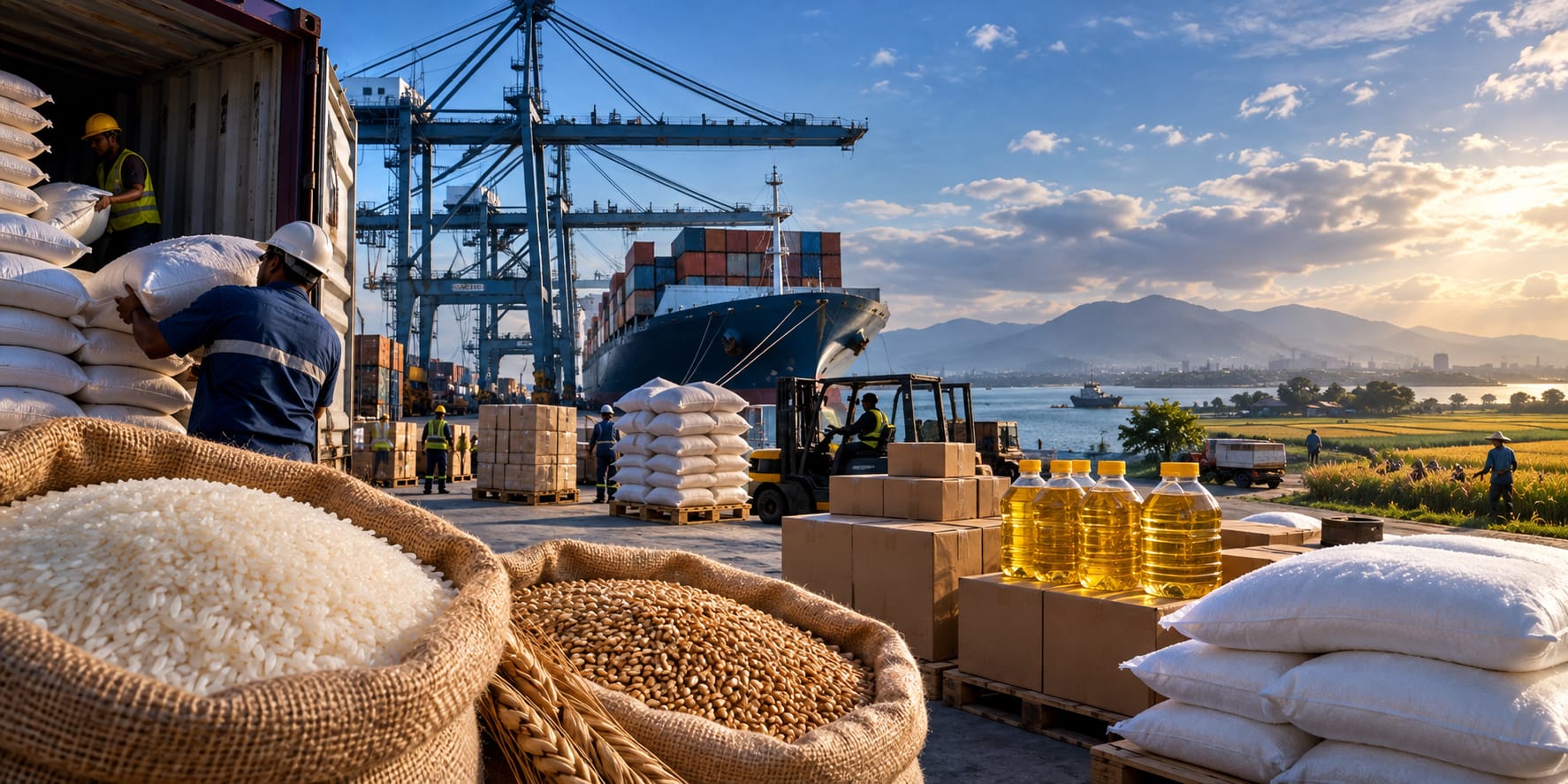
A farming nation that imports its dinner
Around three-quarters of Mozambicans depend on small-scale farming, and the country has some of southern Africa's best-watered soils. Yet the plate of rice on a Maputo dinner table was probably grown in Asia, the bread baked from imported wheat and the cooking oil shipped in. Food is one of the largest drains on Mozambique's scarce dollars.
In 2025 and 2026 the government responded with import quantity limits on 16 products and a state monopoly over rice and wheat imports. This article maps the import bill, explains the new controls, and identifies where local production can genuinely compete.
Where the food dollars go
Cereals are the biggest item: $787m in 2024 and $766m in 2025, according to UN Comtrade data. Animal and vegetable oils added $269m in 2024, flour and other milling products $101m, meat $76m and fish $74m. Together that is well over $1.3bn — around one in seven dollars Mozambique spends on imports.
Rice dominates the cereals bill. Central-bank data show rice imports rising from $318m in 2023 to a record $441m in 2024, partly because domestic output fell to 161,800 tonnes in 2023 — a five-year low — and partly because global rice prices spiked when India restricted exports.
The rice gap
Mozambique imports about 534,000 tonnes of milled rice a year, while domestic production has never exceeded 260,000 tonnes in two decades. In 2023 local farms supplied less than a quarter of the rice Mozambicans ate.
The potential is real. Irrigated schemes along the Limpopo at Chókwè, the Zambezi delta and lowland Zambézia can produce rice; a large project at Matutuíne near Maputo has been projected to cut rice imports by about a fifth; and in March 2026 Mozambican business leaders and a Thai delegation explored partnerships to raise yields. The obstacles are equally real: little irrigation, low yields, poor rural roads, expensive credit, and milling capacity concentrated in the wrong places.
Import limits and a cereals monopoly
In December 2025 the Council of Ministers approved temporary quantity limits on imports of 16 products — including bottled water, pasta, maize flour, salt, cement and tiles — to save foreign exchange and protect local industry. Then Ministerial Decree 132/2025 handed the Mozambique Cereals Institute (ICM) control of rice imports from 1 February 2026 and of wheat imports from 1 May 2026; operators must now source through the ICM.
The government says the aim is transparency, price stability and an end to foreign-currency leakage through over-invoicing. The private-sector confederation, CTA, warned of higher costs, supply disruption and possible trade retaliation, and set up a working group to negotiate. Whether centralisation stabilises prices or simply creates a new bottleneck — as quotas did in the pigeon-pea trade — is the key test for 2026–27.
Imports and hunger are the same story
Food imports are not a luxury problem. Between October 2025 and March 2026 about 3.5 million people — 18% of the population analysed — faced crisis-level acute food insecurity (IPC Phase 3 or worse), concentrated in Cabo Delgado, Nampula, Zambézia, Tete and Sofala. High food prices were the first driver cited, ahead of conflict and climate shocks. Every rise in the cost of imported rice or oil hits these households first.
Where growing at home makes business sense
Not every import can or should be replaced. Mozambique is poorly suited to wheat, for example. But several categories combine a large import bill, local agronomic potential and a protected market — the conditions for viable investment.
Sources
This report draws on 8 cited sources. View them in Sources cited in every report →
Related insights
 Report
The Quiet Majority: Why Mozambique's Small Firms, Not Its Megaprojects, Will Decide Its Jobs Future
New FinScope data show Mozambique's micro, small and medium enterprises involve 9.3 million people and turn over about 341 billion meticais a month. A critical reading of the numbers — and of a growth model that has bet on megaprojects that employ thousands while small firms carry millions.
 Report
AI Without Industrialisation: Can Africa Leapfrog the Traditional Development Model?
Artificial intelligence promises productivity without factories. We built an original model of job exposure across banking, education, retail, logistics and public administration in Mozambique — and found that the binding constraint is not the algorithm, but electricity, connectivity and paper.
 Report
The Oilseed Corridor: Can Nampula Help Fill India's Cooking-Oil Gap?
On 2 October India's oil industry and the governor of Nampula signed up to explore an oilseed corridor through Nacala. India imports 16 million tonnes of vegetable oil a year; Mozambique sends it almost none. We run the numbers on what the deal could — and could not — achieve.