Merchants of the Monsoon: The Indian Diaspora in Mozambique, from Ilha to Maputo
Indian traders were on the Mozambican coast before Vasco da Gama. They survived plague bans, internment after the fall of Goa and the upheaval of independence. Who the community is today, how many there are, and why they matter for the India–Mozambique economy.
Older than the colony, newer than the nation
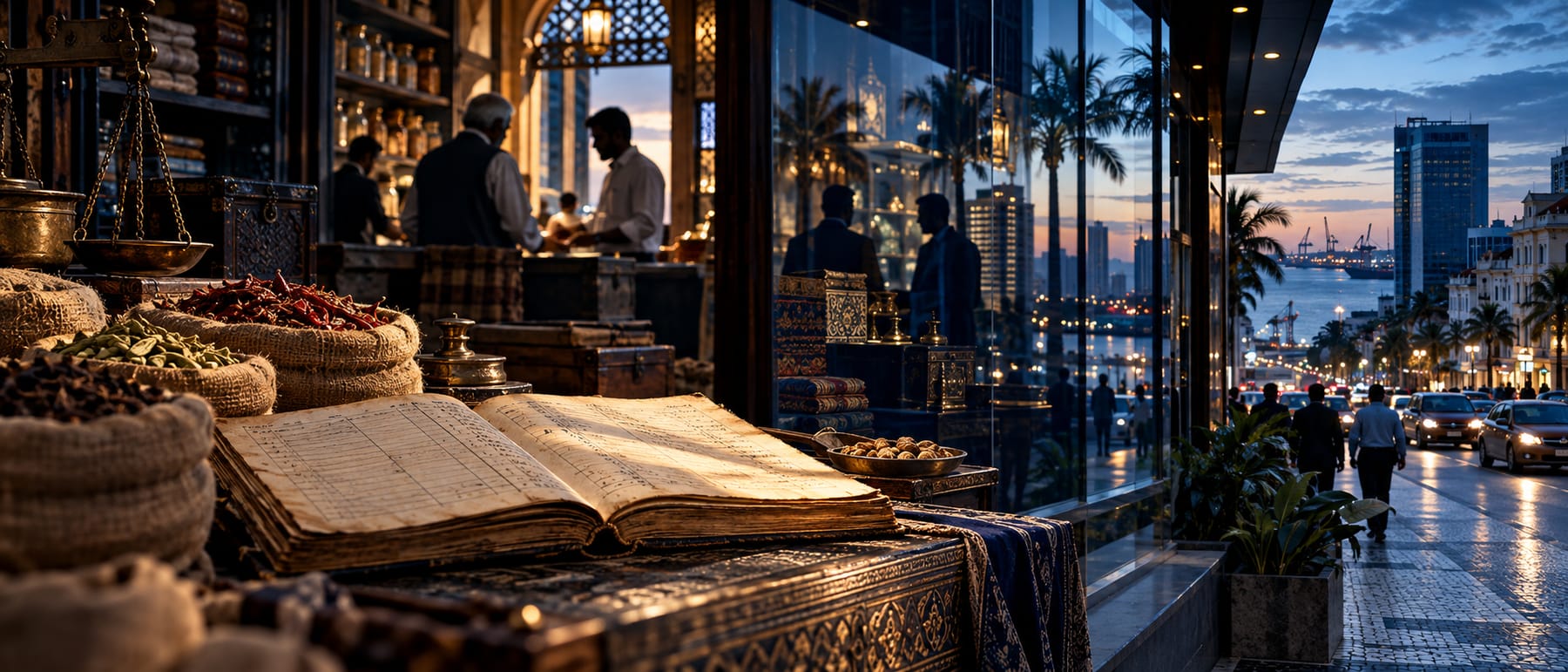
When Vasco da Gama dropped anchor off the Mozambican coast in 1499, he found Hindu merchants already trading there. Indian traders had sailed the monsoon winds to East Africa for centuries — the 12th-century geographer al-Idrisi recorded Indian settlements at Sofala — carrying Gujarati cloth and beads south and returning with ivory and gold.
Their descendants are now Mozambican citizens running shops, wholesalers, cashew warehouses, pharmacies and factories from Maputo to Nampula. This article traces the community's long history, its moments of crisis, its size and shape today, and its role as the human bridge in a $3.8bn trading relationship.
Five centuries in one timeline
- 12th centuryAl-Idrisi records Indian settlements at Sofala, the gold-trading port near today's Beira.
- 1499Vasco da Gama encounters Hindu traders on the Mozambican coast.
- c. 1750–1850Vaniya merchants from Diu and Daman dominate the trade of Gujarati textiles for African ivory through Ilha de Moçambique.
- From 1840Muslim traders from Kutch expand south after the Sultan of Oman moves his court to Zanzibar.
- Late 1800s–1911Gujaratis arrive from South Africa; settlement grows around Delagoa Bay, today's Maputo.
- 1899–1907Asian immigration is halted after a plague outbreak blamed on Indians, then reopened with a landing fee.
- Late 1950sAbout 12,000 Indians live in the colony.
- Dec 1961India annexes Goa. Portugal interns Indian nationals in Mozambique, freezes their assets and expels passport-holders.
- 1975Independence. Many families stay; a large part of the Ismaili community leaves during the 1970s.
The historian Pedro Machado has shown that these merchants were not passive intermediaries: African consumers' tastes in cloth shaped what Gujarati weavers produced, and Indian buyers' demand for ivory shaped what African traders sought. The Indian Ocean was an integrated market long before the word "globalisation" existed.
1961: when Indians became 'enemy aliens'
The darkest moment came in December 1961, when India took Goa, Daman and Diu from Portugal. Lisbon retaliated against Indian nationals across its empire. In Mozambique, according to a February 1962 note by Indian diplomat V.C. Trivedi in the Nehru archives, about 1,500 men, women and children were held in internment camps; shops were sealed and bank accounts frozen.
Portugal insisted that holders of Indian passports leave. At one point a Portuguese emissary suggested 80% of their assets would be confiscated; later even 20% repatriation was in doubt. Departing families could take personal effects and roughly £50–150 in cash. Those with Portuguese nationality — including most children born in the colony — or British passports were allowed to stay, which is one reason the community survived at all.
A trading community built over generations was told, in a matter of weeks, that its nationality made it the enemy.
How many — and who?
Estimates of the community's size vary widely because they count different things. India's Ministry of External Affairs now puts the number of Mozambican nationals of Indian ancestry at almost 20,000, mostly with roots in Gujarat, Goa and Daman and Diu, plus about 3,000 Indian nationals working in Indian firms or as professionals in Mozambican companies. An earlier MEA estimate, still widely cited, put people of Indian origin at about 70,000 and Indian expatriates at 870.
The community is concentrated in Maputo, Nampula, Inhambane, Beira and on Ilha de Moçambique, and is diverse in faith: Hindu families with origins in Diu and Gujarat; Sunni Muslims from Daman and Kutch; Ismaili Khojas, many of whom left in the 1970s; and Catholic Goans. Languages range from Gujarati and Kutchi to Konkani and Urdu — though for the younger generation, Portuguese comes first.
The economic bridge
Indo-Mozambican families have long been central to retail, wholesale and import trade — the networks that move rice, sugar, cooking oil, cloth and hardware into towns where large retailers do not reach. In the colonial era Indian traders built the cashew trade, and many cashew warehouses and export houses still trace their origins to those families.
That position makes the diaspora the natural bridge in today's India–Mozambique relationship. Its members speak both commercial languages, understand Mozambican regulation and informal markets, and keep family and supplier links in Gujarat and Mumbai. As India supplies medicines, rice and fuel and buys coal, gas, pulses and cashew, many of the companies in the middle of those flows are Indo-Mozambican.
The community has also faced pressures. A long-running wave of kidnappings for ransom in Maputo and other cities, widely reported since the early 2010s, has disproportionately targeted businesspeople of South Asian origin, prompting some families to move capital or relatives abroad.
The next generation
Younger Indo-Mozambicans are shifting from trade into professions, technology, healthcare and services, and increasingly into manufacturing and agro-processing. India's 117 scholarship places for Mozambican students in 2026 and around 100 short-term training courses a year deepen the people-to-people link beyond the diaspora itself.
For Mozambique, the community's value lies in what it can broker: Indian investment in processing, pharmaceuticals and logistics, and Mozambican access to Indian suppliers and finance. For India, it is an embedded network that no embassy can replicate. Security, a predictable business climate and easier visas for family and business travel would let that bridge carry more.
Sources
This report draws on 6 cited sources. View them in Sources cited in every report →
Related insights
 Report
The Quiet Majority: Why Mozambique's Small Firms, Not Its Megaprojects, Will Decide Its Jobs Future
New FinScope data show Mozambique's micro, small and medium enterprises involve 9.3 million people and turn over about 341 billion meticais a month. A critical reading of the numbers — and of a growth model that has bet on megaprojects that employ thousands while small firms carry millions.
 Report
AI Without Industrialisation: Can Africa Leapfrog the Traditional Development Model?
Artificial intelligence promises productivity without factories. We built an original model of job exposure across banking, education, retail, logistics and public administration in Mozambique — and found that the binding constraint is not the algorithm, but electricity, connectivity and paper.
 Report
The Oilseed Corridor: Can Nampula Help Fill India's Cooking-Oil Gap?
On 2 October India's oil industry and the governor of Nampula signed up to explore an oilseed corridor through Nacala. India imports 16 million tonnes of vegetable oil a year; Mozambique sends it almost none. We run the numbers on what the deal could — and could not — achieve.