The Price of a Dollar: Inside Mozambique's Currency Squeeze
For five years the metical has sat at about 63.9 to the dollar. Economists say it is worth 90 or more; importers say they cannot buy dollars at any price. What the de facto peg has cost, what a devaluation would mean, and how businesses can prepare.
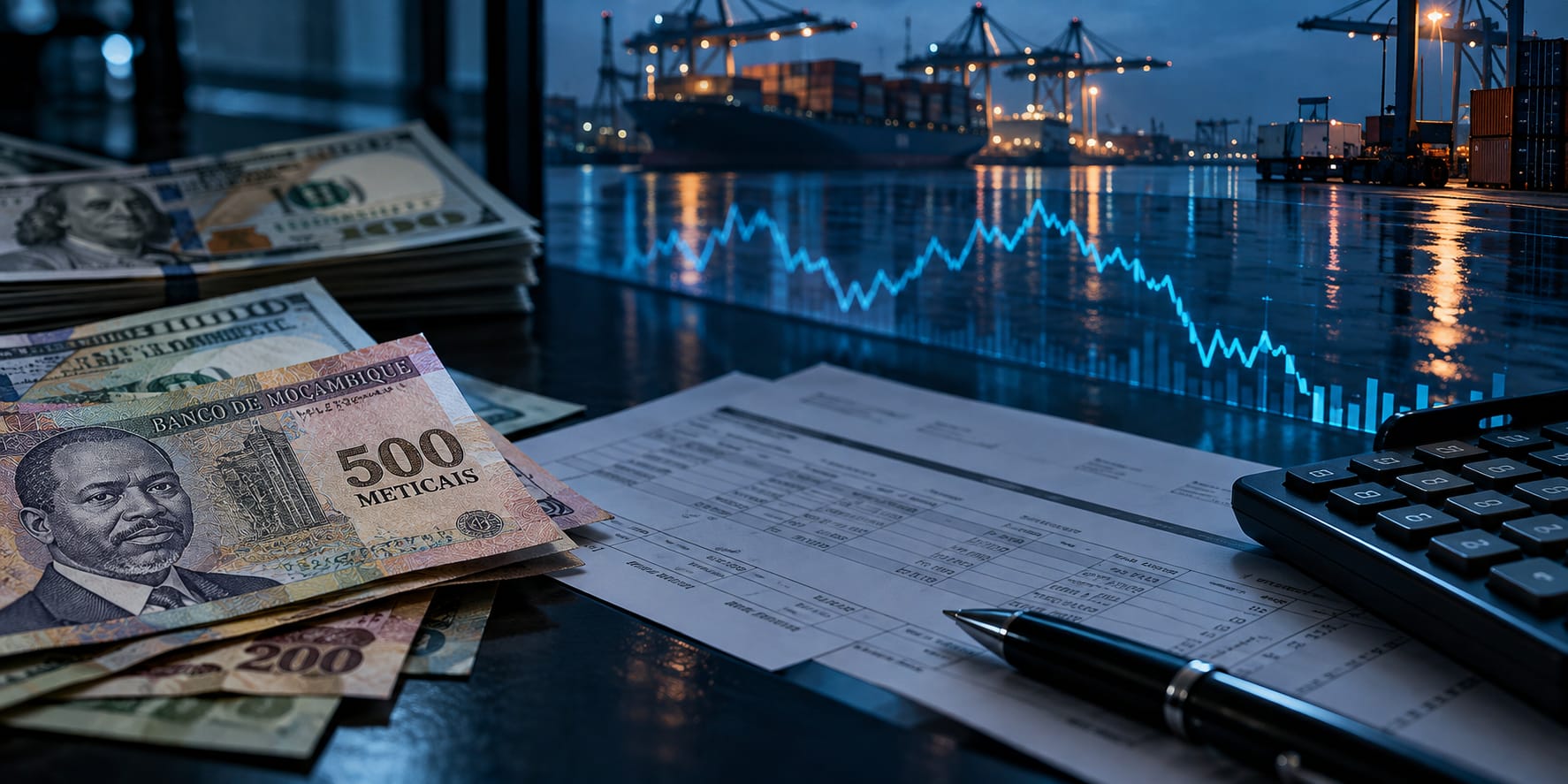
A stable price for something you cannot buy
On paper, Mozambique has one of Africa's most stable currencies. The Bank of Mozambique's reference rate on 4 September 2026 was 63.91 meticais to the dollar — almost exactly where it has been for five years. In practice, importers queue for weeks for foreign exchange, banks ration dollars, and an estimated $800m of external payments has been stuck in a backlog.
The peg has delivered low inflation. It has also starved the economy of dollars, delayed an IMF programme and pushed hundreds of firms out of business. In 2026 the government signalled it would accept a devaluation. This article explains the squeeze and what comes next.
Five years at 63.9
Mozambique has no formal currency peg. But since 2021 the central bank has held the metical in a very narrow band around 63.9 to the dollar, intervening with reserves and tight rules on bank foreign-currency positions. The result has been predictability for importers lucky enough to obtain dollars, and a sharp fall in inflation from a peak of almost 13% in July 2022 to 3.2% in 2025.
The cost is that the price of a dollar no longer clears the market. With the official rate below what buyers would pay, demand for dollars exceeds supply, and the shortage is managed by queue rather than price. Commentators following the 2025 IMF mission reported that the Fund was pressing for devaluation; many economists put a fair rate at 90 to 100 meticais.
What the dollar shortage has cost
A study released in May 2026 found that difficulty obtaining foreign currency cut firms' import capacity by about 40%, and estimated that more than 500 companies had closed with about 15,000 jobs lost. Its authors estimated that, historically, each 1% depreciation of the metical has raised inflation by about 0.3 points and reduced growth by about 0.65%.
Reserves are thin. In March 2026 the government used about $630m of central-bank reserves to repay the IMF early, a move the central bank reportedly opposed and local bankers argued should have gone to clearing the roughly $800m external payment backlog instead. In May the central bank raised banks' reserve requirements to drain metical liquidity that could otherwise chase dollars.
The peg did not make dollars cheap. It made them scarce.
Rates down, requirements up, IMF back
Monetary policy has loosened as inflation fell. The policy rate, MIMO, peaked at 17.25% in 2023; by October 2025 it was 9.75%, and it was cut again to 9.25% in 2026, where the central bank held it in July, citing risks from the Middle East conflict and fuel prices. Real interest rates — the policy rate minus inflation — remain high, at around six points.
The bigger shift is political. After months of stalemate, the IMF agreed in May 2026 to send a team in June to discuss a new programme, after Mozambique cleared its IMF debt, hired debt advisers and signalled acceptance of devaluation. The question is no longer whether the metical will move, but how — in one step, or gradually.
Three paths for the metical
A devaluation is mechanical for importers: a container of goods priced in dollars costs more meticais. The table below shows how landed costs change at different exchange rates, before any change in the supplier's dollar price. Oxford Economics, assuming a gradual devaluation, expects inflation to rise to 4.8% in 2026 and 8.4% in 2027.
How to prepare
Earn some dollars
Businesses with dollar or rand revenue — exports, tourism, services to gas projects — have a natural hedge. Even a small export line changes a company's FX position.Re-price contracts
Add exchange-rate adjustment clauses to long-term supply and rental contracts, and shorten price-validity periods on quotes.Manage stock carefully
Holding imported stock before a devaluation preserves margin — but ties up cash at high interest rates. Model both sides.Source closer to home
Local and regional suppliers, priced in meticais or rand, reduce dollar exposure. Food and packaging are obvious candidates.Talk to your bank early
Banks prioritise customers with predictable FX needs and clean documentation. Plan import payments months ahead.Watch the IMF
A new IMF programme is the most likely trigger for an exchange-rate adjustment — and for new dollar inflows that ease the shortage.This is general information, not financial advice. Exchange-rate decisions depend on policy choices that may differ from the scenarios shown.
Sources
This report draws on 9 cited sources. View them in Sources cited in every report →
Related insights
 Report
The Quiet Majority: Why Mozambique's Small Firms, Not Its Megaprojects, Will Decide Its Jobs Future
New FinScope data show Mozambique's micro, small and medium enterprises involve 9.3 million people and turn over about 341 billion meticais a month. A critical reading of the numbers — and of a growth model that has bet on megaprojects that employ thousands while small firms carry millions.
 Report
AI Without Industrialisation: Can Africa Leapfrog the Traditional Development Model?
Artificial intelligence promises productivity without factories. We built an original model of job exposure across banking, education, retail, logistics and public administration in Mozambique — and found that the binding constraint is not the algorithm, but electricity, connectivity and paper.
 Report
The Oilseed Corridor: Can Nampula Help Fill India's Cooking-Oil Gap?
On 2 October India's oil industry and the governor of Nampula signed up to explore an oilseed corridor through Nacala. India imports 16 million tonnes of vegetable oil a year; Mozambique sends it almost none. We run the numbers on what the deal could — and could not — achieve.