Money in Your Pocket: Mozambique's Mobile Money Revolution
Mozambicans now hold almost four mobile wallets for every bank account. 446,000 agents, a new instant-payment system and falling card-terminal numbers are rewiring how shops, restaurants and workers get paid. The data, the gaps and the business playbook.
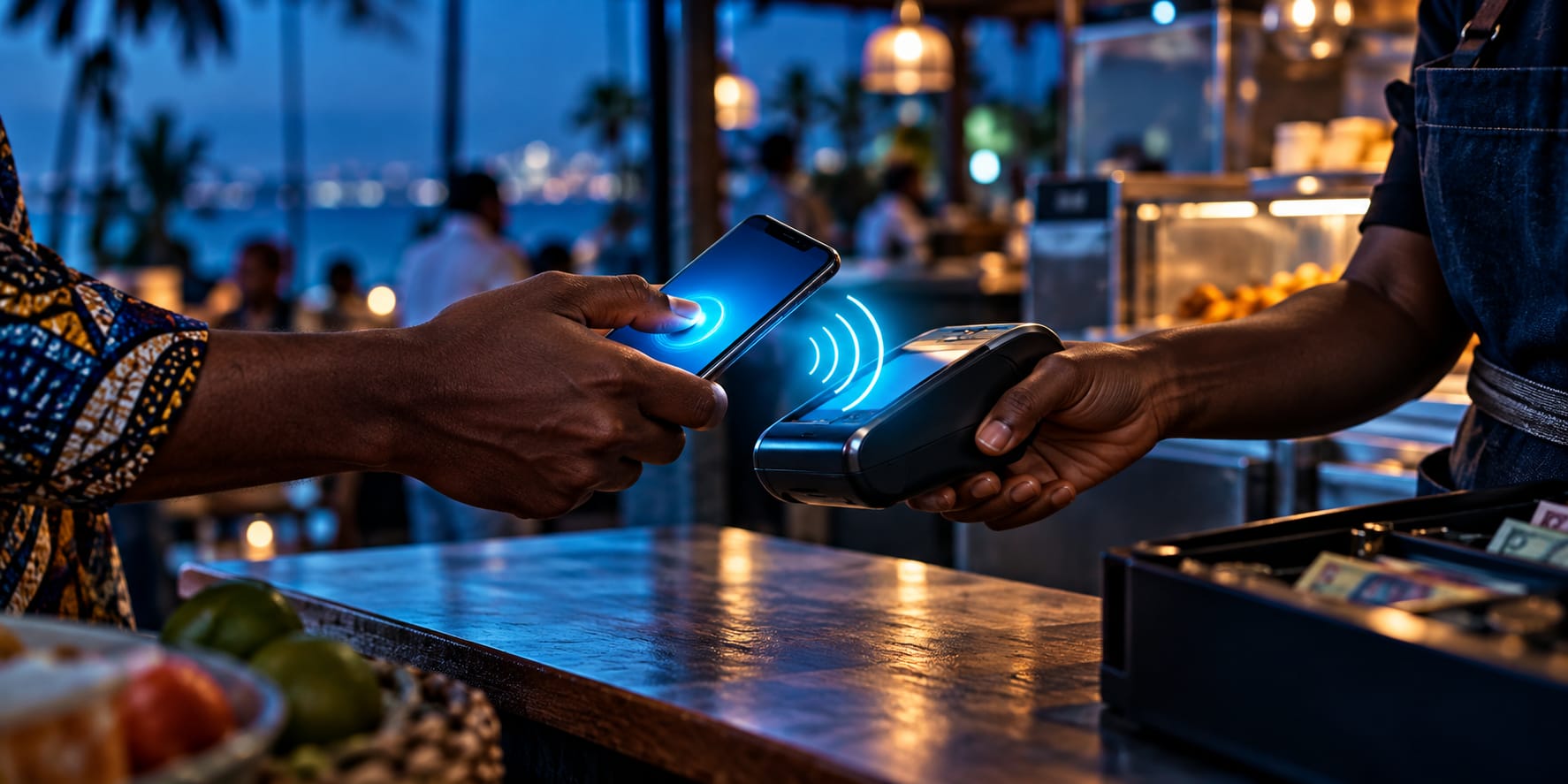
The bank in the phone
In a Maputo market or a Nampula restaurant, the most common way to pay is no longer cash or card — it is a code typed into a phone. Mozambique's three mobile-money services, M-Pesa, e-Mola and mKesh, have grown so fast that the country now has almost four electronic-money accounts for every bank account.
This article sets out the numbers, explains how the system works, identifies who is still left out — especially women and rural households — and shows what the shift means for retailers, restaurants and employers.
Wallets overtake banks — by a mile
By the end of November 2025, Mozambique had 24.6 million mobile-wallet accounts, up from 19.9 million a year earlier — a jump of almost 24%. Bank accounts grew just 7% to 6.7 million. Because many people hold more than one wallet, the number of e-money accounts now exceeds the adult population: 131 per 100 adults by mid-2026, against 34 bank accounts.
The physical banking network is shrinking at the same time. ATMs dipped to 1,383 at the end of 2025, and card terminals fell 9% to 32,236 as banks removed inactive and unprofitable machines. Mobile-money agents — corner shops and kiosks that exchange cash for e-money — rose by 42% to 446,604, reaching every one of the country's 154 districts.
Mozambique is not moving from cash to cards. It is skipping cards altogether.
Three wallets and a new national switch
Each of Mozambique's three mobile networks runs one wallet: M-Pesa on Vodacom, e-Mola on Movitel and mKesh on Tmcel. Vodacom alone had about 12.5 million mobile customers in March 2025, though its average revenue per customer fell, reflecting pressure on consumer incomes.
For years the wallets were walled gardens. On 2 March 2026 the Bank of Mozambique's Instant Payment System, run by the interbank switch SIMO, went live, with mandatory participation for all wallets and banks. It runs 24 hours a day, every day, with daily limits of 200,000 meticais for individuals and 500,000 meticais for companies. For the first time, a payment from an e-Mola wallet to an M-Pesa wallet or a bank account can settle instantly.
Usage is shifting too: transfers made up 48% of e-money transactions in 2025, up from 41% in 2024, while withdrawals and payments fell as a share — a sign that people increasingly keep money in the system rather than cashing out.
Who is still left out
Inclusion is uneven. In mid-2026 men held 145 e-money accounts per 100 adult men, women 119 per 100. The bank-account gap is starker: 45 per 100 men against 22 per 100 women. Access to credit widened between the sexes in 2025, rising to 66% among men but only 34% among women.
Geography matters as well, though the fastest growth is now in the poorest regions: agents grew by more than 45% in Niassa and Cabo Delgado and by 40% in Zambézia in 2025. Cabo Delgado's financial inclusion index rose from 23.3 to 25.8.
What it means for shops, restaurants and employers
Accept every wallet
Customers split across M-Pesa, e-Mola and mKesh. Displaying merchant codes for all three — and bank instant payments — avoids lost sales.Reconcile daily
Mobile payments create a digital trail but also new reconciliation work. End-of-day closing should count cash, each wallet and each card terminal separately.Pay staff digitally
Paying wages into wallets cuts cash-handling risk and gives employees a transaction history they can use to access credit.Watch the limits
Instant-payment caps of 200,000 MT (individuals) and 500,000 MT (companies) a day shape how suppliers can be paid.Use the data
Wallet transaction histories are becoming the basis for small-business and consumer lending.Mind the fees
Merchant and cash-out fees vary by wallet; compare them against the cost and risk of handling cash.What comes next
- Interoperability in practice. Whether the instant-payment system makes cross-wallet payments cheap and routine, or remains a back-office link.
- Credit on mobile. Nano-loans and merchant credit built on wallet data could close part of the small-business finance gap — or create a debt problem if poorly regulated.
- Cross-border. Mobile remittances from South Africa and payments for regional trade are the next frontier.
- Closing the gender gap. Women's e-money accounts grew 24% in 2025; matching that in credit is the harder task.
Sources
This report draws on 7 cited sources. View them in Sources cited in every report →
Related insights
 Report
The Quiet Majority: Why Mozambique's Small Firms, Not Its Megaprojects, Will Decide Its Jobs Future
New FinScope data show Mozambique's micro, small and medium enterprises involve 9.3 million people and turn over about 341 billion meticais a month. A critical reading of the numbers — and of a growth model that has bet on megaprojects that employ thousands while small firms carry millions.
 Report
AI Without Industrialisation: Can Africa Leapfrog the Traditional Development Model?
Artificial intelligence promises productivity without factories. We built an original model of job exposure across banking, education, retail, logistics and public administration in Mozambique — and found that the binding constraint is not the algorithm, but electricity, connectivity and paper.
 Report
The Oilseed Corridor: Can Nampula Help Fill India's Cooking-Oil Gap?
On 2 October India's oil industry and the governor of Nampula signed up to explore an oilseed corridor through Nacala. India imports 16 million tonnes of vegetable oil a year; Mozambique sends it almost none. We run the numbers on what the deal could — and could not — achieve.