The Narrow Sea: Shipping, Islands and Great-Power Rivalry in the Mozambique Channel
A 1,600km strait between Mozambique and Madagascar carries a large share of the world's oil tankers, and more every time the Red Sea closes. France, India, China and the littoral states are all positioning. A guide to the channel's traffic, disputes, threats and opportunities.
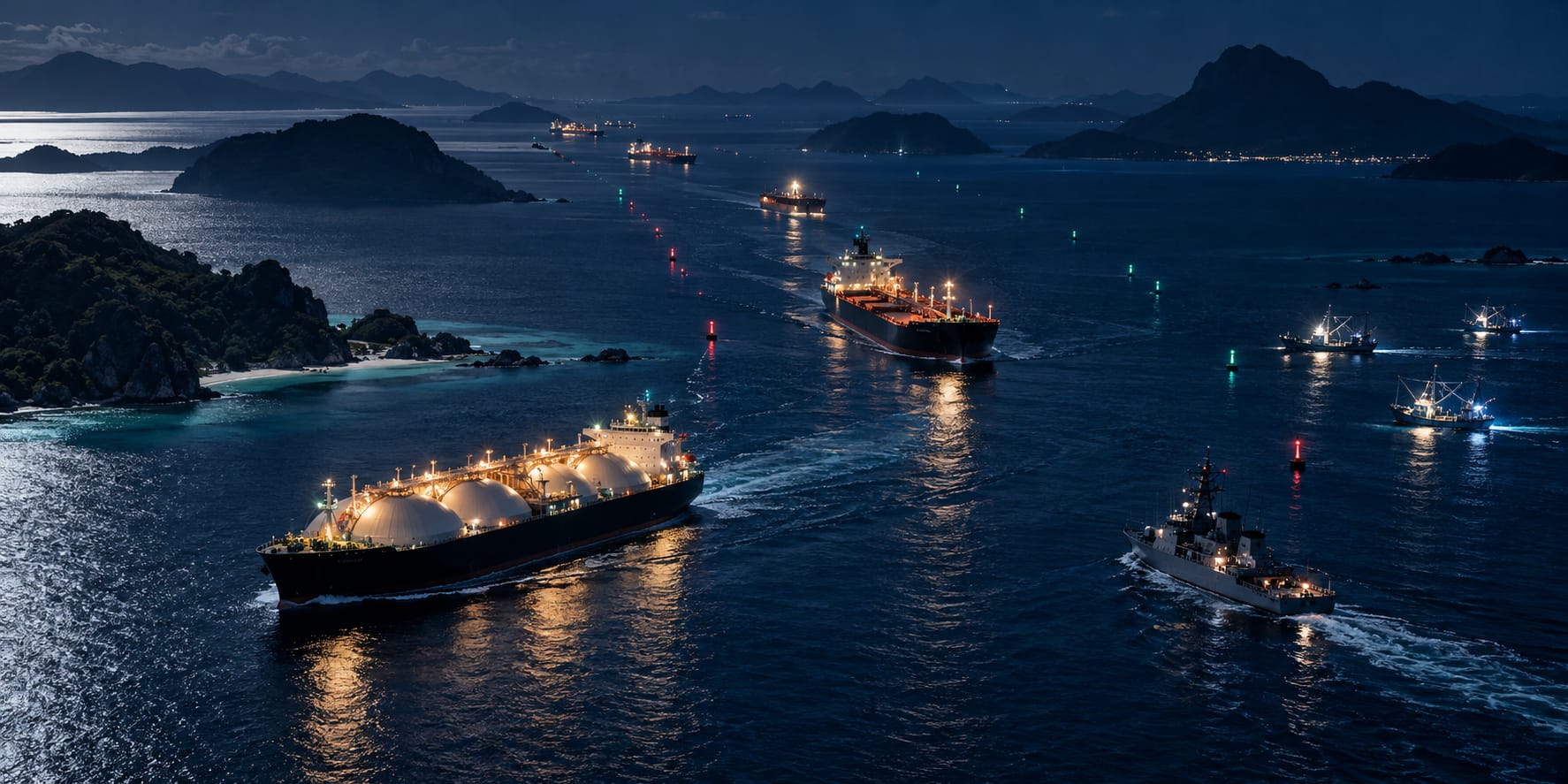
A strait the world forgets — until Suez closes
Look at a map of world shipping and one lane runs past Mozambique's front door. Tankers from the Gulf heading to the Atlantic, bulk carriers from Brazil heading to China, and, since 2023, container ships fleeing the Red Sea all funnel through or past the Mozambique Channel, the stretch of the Indian Ocean between Mozambique and Madagascar.
Three rivalries meet in this narrow sea: a colonial-era dispute over French-held islands, a contest for influence between India, China and the West, and the struggle of fragile coastal states to police waters rich in gas, fish and trafficking routes. This article maps them.
When the Red Sea closes, the channel fills
Since attacks on shipping in the Red Sea began in late 2023, carriers have repeatedly abandoned the Suez route for the long way round Africa, adding roughly two weeks to Asia–Europe voyages. Traffic around southern Africa stayed elevated through 2025 and surged again in April 2026, when renewed Middle East escalation drove tanker movements around the Cape to their highest levels since early 2025.
For Mozambique, more passing ships are mostly a missed opportunity. Durban, Port Louis and Walvis Bay capture most bunkering, ship supply and crew changes. Maputo, Beira and Nacala could compete for a share of that business — fuel, provisions, repairs and crew transfers — if they offered the services and the paperwork speed that shipping lines demand.
Five specks of land, 640,000 km² of sea
Scattered around Madagascar are five French-held islands and atolls — Europa, the Glorieuses, Juan de Nova, Tromelin and Bassas da India — with a combined land area of under 40 km². Around them France claims exclusive economic zones of about 640,000 km², and more than a million square kilometres together with Mayotte and Réunion.
Madagascar has claimed most of the islands since 1972, and a non-binding 1979 UN General Assembly resolution called for their return. The Comoros claims the Glorieuses; Mauritius claims Tromelin. In 2025 France and Madagascar reopened talks, with President Macron reportedly favouring joint management over transfer of sovereignty. Political upheaval in Madagascar — the military took power in October 2025 after mass youth protests — adds uncertainty to any settlement.
At stake is not the land, which is tiny, but the seabed and fish around it — in a basin where giant gas fields have already been found.
The powers in the channel
France is the resident power, with Mayotte, Réunion and the Scattered Islands, military garrisons and the largest maritime footprint. India is the most active newcomer: it has given Mozambique six fast interceptor craft since 2019 for counter-terrorism and anti-piracy work, trains its navy, links Madagascar's maritime information centre with its own Information Fusion Centre, and built an airstrip and jetty on Mauritius's Agaléga island. Its companies own 30% of Mozambique's Area 1 gas. China has CNPC in Area 4, an embassy and lending in the Comoros, and a growing commercial presence across all three coastal states. The United States is present through ExxonMobil and security assistance.
Piracy, insurgents, traffickers and spills
- Piracy. Somali-linked piracy reached the channel around 2010, including the hijacking of an Indian merchant vessel. Analysts warn of a revival as naval attention shifts to the Red Sea.
- Insurgency on the coast. Insurgents in Cabo Delgado seized the port of Mocímboa da Praia and attacked Palma in 2021, and have used boats along the coast and to nearby islands.
- Trafficking. The channel is a long-standing route for illicit goods, including narcotics, moving by dhow and container towards southern Africa and beyond.
- Illegal fishing. Weak surveillance across vast exclusive economic zones invites foreign fleets.
- Environmental risk. The 2020 grounding of the MV Wakashio off Mauritius spilled about 1,000 tonnes of oil — a warning for a channel that will soon carry far more LNG and crude.
Turning a passing lane into an economy
The channel's traffic will only grow as Mozambique's LNG comes on stream and Red Sea risks persist. The opportunities are practical: bunkering and ship supply at Maputo and Nacala, maritime surveillance and coast-guard services, offshore logistics for gas projects, fisheries management with neighbours, and regional cooperation with Madagascar, the Comoros and France on search and rescue and oil-spill response.
Sources
This report draws on 7 cited sources. View them in Sources cited in every report →
Related insights
 Report
The Quiet Majority: Why Mozambique's Small Firms, Not Its Megaprojects, Will Decide Its Jobs Future
New FinScope data show Mozambique's micro, small and medium enterprises involve 9.3 million people and turn over about 341 billion meticais a month. A critical reading of the numbers — and of a growth model that has bet on megaprojects that employ thousands while small firms carry millions.
 Report
AI Without Industrialisation: Can Africa Leapfrog the Traditional Development Model?
Artificial intelligence promises productivity without factories. We built an original model of job exposure across banking, education, retail, logistics and public administration in Mozambique — and found that the binding constraint is not the algorithm, but electricity, connectivity and paper.
 Report
The Oilseed Corridor: Can Nampula Help Fill India's Cooking-Oil Gap?
On 2 October India's oil industry and the governor of Nampula signed up to explore an oilseed corridor through Nacala. India imports 16 million tonnes of vegetable oil a year; Mozambique sends it almost none. We run the numbers on what the deal could — and could not — achieve.