The Pulse of the North: How India's Dal Bowl Sets the Income of Mozambique's Farmers
Pigeon peas and cashews are the cash crops of northern Mozambique — and India is the customer that decides their price. A story of quotas, price crashes, a $374m comeback plan and where the margin really goes.
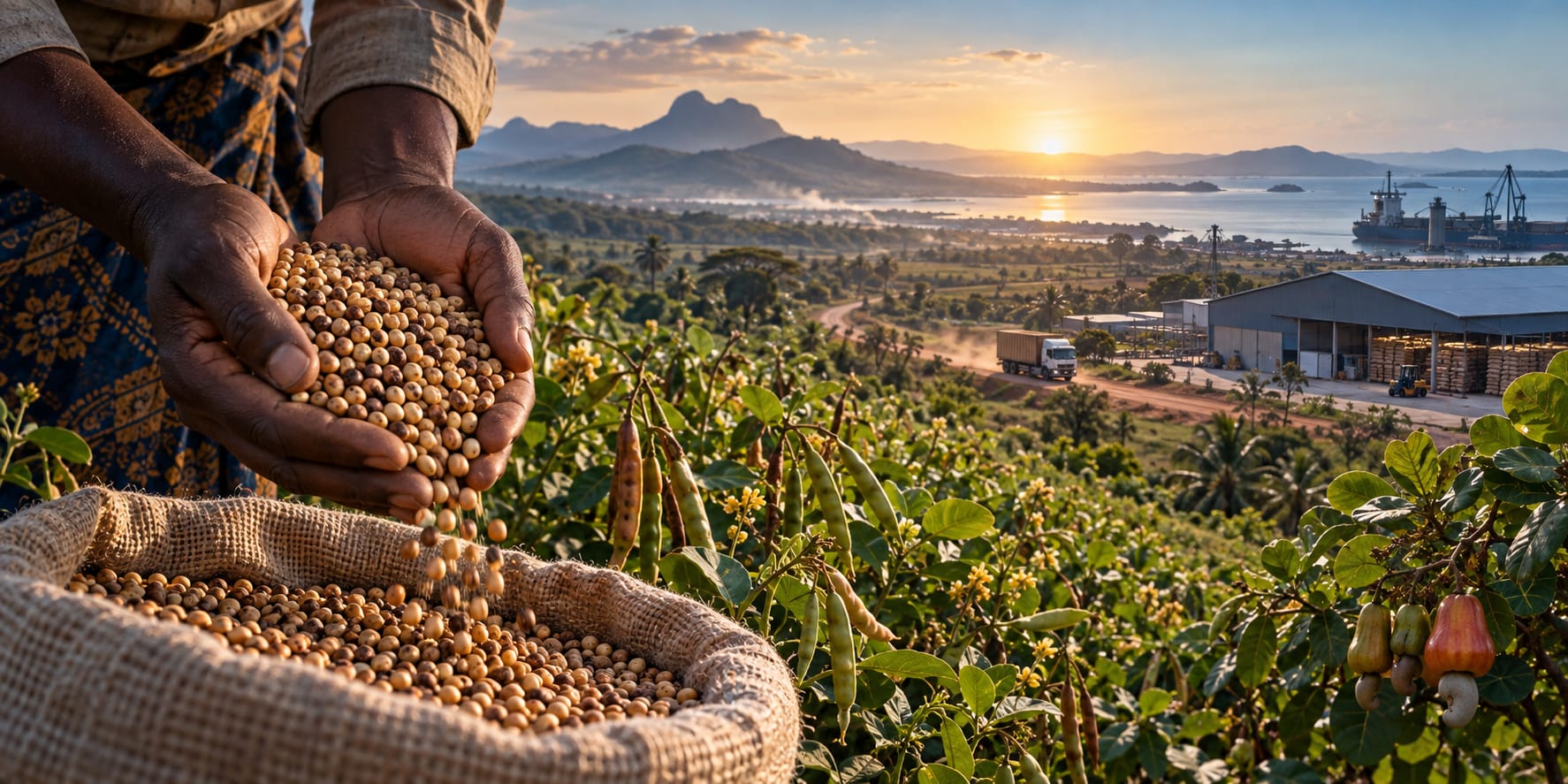
A bowl of dal in Delhi, a harvest in Zambézia
When a family in Delhi or Lucknow cooks arhar dal, there is a fair chance the lentils were grown on a smallholding in Zambézia or Nampula. Pigeon peas — feijão bóer in Mozambique, tur in India — have become the north's most important cash crop, grown almost entirely for a single foreign customer.
That dependence has made fortunes and broken them. This article traces how Indian policy — quotas, duties, harvests — travels down the supply chain to the farm gate, why cashew is staging a comeback, and what it would take for more of the farmer's dollar to stay in Mozambique.
A crop grown for one customer
Pigeon peas suit northern Mozambique: drought-tolerant, nitrogen-fixing and easy to intercrop with maize. Mozambicans eat little of them. Almost the entire harvest is aggregated by traders in Nampula and Zambézia, trucked to Nacala and shipped to India — practically the only significant importer on the world market.
In July 2016, Prime Minister Narendra Modi and President Filipe Nyusi signed a memorandum of understanding under which India committed to buy Mozambican pigeon peas duty-free, with an assured volume that would double from 100,000 tonnes to 200,000 tonnes by 2020-21. The quota was renewed at 200,000 tonnes in November 2020. Mozambique exported more than 170,000 tonnes in 2016 alone, worth over $120m.
India has since gone further. Its "free" import regime for tur — no duty and no quantity limit — has been repeatedly extended and now runs to 31 March 2027, which makes the 200,000-tonne floor largely irrelevant for now.
2017: when India's harvest broke Mozambique's price
The risk of a single buyer became painfully clear in 2017. India harvested a record 4.8 million tonnes of pigeon peas and, to protect its own farmers, restricted imports. In Mozambique the farmgate price for pigeon peas — above 40 meticais a kilo in 2016, and up to 50 in places — collapsed to around 5 meticais by October 2017.
A survey of 447 households by the World Food Programme and the International Growth Centre found that 96% grew the crop. In Zambézia, families received on average about 11,600 meticais less than they had expected for the season — a large share of annual cash income in rural Mozambique. Prices also varied far more between districts than transport costs could explain, a sign of thin, uncompetitive buying.
A rule change in New Delhi can cut the price a Zambézian farmer receives by close to 90% in a single season.
Quotas, gatekeepers and the 2023 jam at Nacala
Quotas create rents, and rents attract gatekeepers. In 2023 Mozambique moved to manage exports through licensing. Indian buyers complained that supply had become erratic; the Indian Pulses and Grains Association alleged that officials were favouring a single exporter, and Indian officials warned they might revoke the MoU altogether. Mozambique's private-sector confederation, CTA, said the disruption hit about a fifth of all agricultural exports, because the same traders and warehouses also handle sesame, soya and cashew.
- Jul 2016Modi–Nyusi MoU: duty-free access and an assured purchase rising to 200,000 tonnes.
- 2017Record Indian harvest; import curbs; Mozambican farmgate prices collapse.
- Nov 2020200,000-tonne assured-purchase quota renewed.
- Nov 2023Indian traders allege favouritism; New Delhi weighs revoking the MoU.
- Dec 2023About 150,000 tonnes sit at Nacala; storage costs exceed 80m meticais a month. On 14 December the finance ministry opens exports to all operators.
- Mar 2026India extends free, duty-free tur imports to 31 March 2027.
By late November 2023 about 230,000 tonnes had been exported and some 160,000 tonnes were still in warehouses — only around 60% of the crop shipped, against a normal 90% by December.
Cashew's comeback
Cashew is the older story. In 1973 Mozambique produced around 210,000 tonnes and was among the world's leading suppliers. After independence and the civil war, output collapsed to 15,000–20,000 tonnes a year. It has climbed back slowly: 195,400 tonnes were marketed in 2024/25, and the government forecast 218,900 tonnes for 2025/26, ranking Mozambique seventh in the world.
2025 was a breakout year for exports. Volumes nearly doubled from 48,000 to 93,000 tonnes, and value almost tripled from $44m to $122m, with India and Vietnam the main buyers — both of which shell the nuts and re-export the kernels. The government's 2025–2034 value-chain programme, budgeted at $374m, targets 689,000 tonnes of production by 2034 and processing capacity of more than 480,000 tonnes, up from about 40,000.
The reference farmgate price was held at 45 meticais a kilo for 2025/26. The test of the new programme is whether shelling returns to Mozambique — several processing plants closed in recent years for lack of capital and raw nuts — or whether the country remains a supplier of raw cashew to Indian and Vietnamese factories.
Two crops, one lesson: own more of the chain
Pigeon peas and cashew share a structure: millions of smallholders, a few aggregators, export of an unprocessed product, and processing — with most of the margin — done in India or Vietnam. The difference is that cashew has an established domestic processing history and a funded government plan; pigeon peas have neither.
Making the farmer's dollar stick
Mill some dal at home
Splitting and polishing pigeon peas into tur dal in Nampula would add value and open regional markets in East Africa and the Gulf, reducing reliance on Indian policy.Transparent export licensing
Open, rules-based licensing with published volumes would remove the gatekeeper rents that caused the 2023 jam.Warehouse receipts
Certified storage lets farmers borrow against their crop and sell later, instead of dumping at harvest when prices are lowest.Price information
SMS price bulletins from Nacala and Indian wholesale markets would narrow the unexplained gaps between districts.Shell cashew locally
Mechanised shelling, cheaper power and working-capital finance are the difference between exporting raw nuts and exporting kernels.Indian processors in Mozambique
Indian dal millers and cashew processors already buy the crop. Joint ventures inside Mozambique would align both countries' interests.Sources
This report draws on 8 cited sources. View them in Sources cited in every report →
Related insights
 Report
The Quiet Majority: Why Mozambique's Small Firms, Not Its Megaprojects, Will Decide Its Jobs Future
New FinScope data show Mozambique's micro, small and medium enterprises involve 9.3 million people and turn over about 341 billion meticais a month. A critical reading of the numbers — and of a growth model that has bet on megaprojects that employ thousands while small firms carry millions.
 Report
AI Without Industrialisation: Can Africa Leapfrog the Traditional Development Model?
Artificial intelligence promises productivity without factories. We built an original model of job exposure across banking, education, retail, logistics and public administration in Mozambique — and found that the binding constraint is not the algorithm, but electricity, connectivity and paper.
 Report
The Oilseed Corridor: Can Nampula Help Fill India's Cooking-Oil Gap?
On 2 October India's oil industry and the governor of Nampula signed up to explore an oilseed corridor through Nacala. India imports 16 million tonnes of vegetable oil a year; Mozambique sends it almost none. We run the numbers on what the deal could — and could not — achieve.