Wired Together: Power, Gas, Labour and the South Africa–Mozambique Economy
Electricity flows south from Cahora Bassa, gas flows south through a 865km pipeline, and miners and minerals cross at Ressano Garcia. In 2026 the shutdown of the Mozal smelter showed how tightly the two economies are bound — and how fragile the bonds are.
The neighbour that matters most
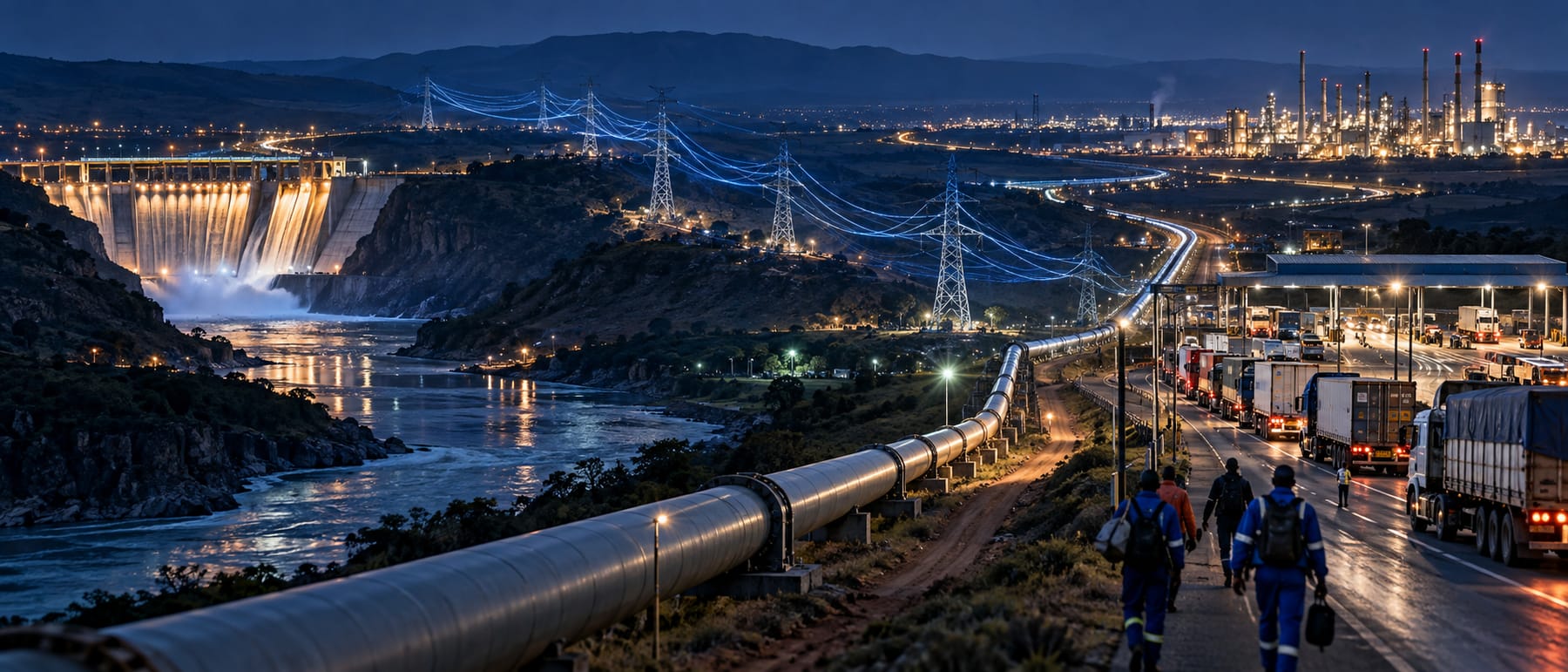
For all the talk of India, China and the Gulf, Mozambique's most important economic relationship is still with the country next door. South Africa sells Mozambique a quarter of everything it imports, buys its electricity and gas, employs its miners, sends its tourists and ships its minerals through Maputo.
This interdependence is a strength when it works and a shared vulnerability when it does not. The past two years tested it repeatedly: post-election protests closed the main border, drought hit Cahora Bassa, South Africa's gas supply from Mozambique began running down, and a failed power negotiation shut Mozambique's biggest factory.
A lopsided but essential trade
In 2024, according to Bank of Mozambique data, South Africa supplied $2.09bn of Mozambique's imports — electricity, cars, steel bars, flour, and much of what fills Maputo's supermarket shelves. Mozambique sold South Africa $1.21bn, mostly natural gas, electricity, coal and bananas, making it the third-largest destination for Mozambican exports after India and China.
The imbalance reflects South Africa's manufacturing base and its retailers' reach into southern Mozambique. But the flows also run through Mozambique: the Port of Maputo handles about half of South Africa's chrome exports, earning transit revenue that does not appear in bilateral trade figures at all.
Cahora Bassa: Mozambique's power, South Africa's customer
The roughly 2,075 MW Cahora Bassa dam on the Zambezi — built in the colonial era largely to supply South Africa — still sends most of its output south. In 2024 its operator, HCB, delivered 12,351 GWh: 8,319 GWh to Eskom (66%), 3,451 GWh to Mozambique's utility EDM (28%) and 499 GWh to Zimbabwe's ZESA (4%).
The flow also runs back. Mozal, the aluminium smelter outside Maputo, needs about 940 MW of continuous power, and Eskom supplied roughly 90% of it through a long-standing arrangement linked to Cahora Bassa. When that contract expired at the end of March 2026 and no affordable replacement was agreed, South32 placed Mozal on care and maintenance.
Mozambique's largest factory closed not for lack of electricity in Mozambique, but for lack of a price both neighbours could accept.
The cost is large. Mozal produced 355,000 tonnes of aluminium in the year to June 2025, supported about 4,000 direct and 20,000 indirect jobs, and accounted for a big share of Mozambique's export earnings.
The pipeline and the gas cliff
Since 2004, gas from Sasol's Pande and Temane fields in Inhambane province has flowed through the ROMPCO pipeline to Secunda in South Africa, feeding Sasol's synthetic-fuels plant and industrial users across Gauteng and KwaZulu-Natal. South African officials say the supply supports more than 13,000 direct jobs and around 5% of South Africa's GDP.
The fields are running down. Output is expected to drop sharply by 2028, and Sasol has indicated supply only until about 2030. South Africa warns that up to 70,000 jobs are at risk. In 2026 the two governments agreed to pursue an LNG import terminal to keep gas flowing through ROMPCO and to discuss extending the pipeline's concession — potentially at Matola, where a 4.9 mtpa LNG jetty is planned.
The irony is sharp: Mozambique is about to become one of the world's largest LNG exporters from the north, while the south of the country — and its neighbour — may have to import LNG.
Miners, migrants and the border
Mozambicans have worked in South African mines for well over a century, recruited through agencies such as TEBA. About 17,000 still did in 2022, and more than 15,000 crossed home through Ressano Garcia for the December holidays. Many more work on South African farms, construction sites and in the informal economy. In 2026, more than 1,200 former mineworkers were identified to receive about R148m in unclaimed benefits.
The Lebombo–Ressano Garcia crossing is the busiest on the corridor and a recurring bottleneck: truck queues stretch for kilometres when systems fail on either side, and the post-election protests of late 2024 closed it repeatedly — disrupting fuel, food and mineral flows in both directions.
From dependence to partnership
- Price power regionally. The Mozal failure shows that bilateral power deals need regional pricing through the Southern African Power Pool, not one-off negotiations.
- Solve the gas cliff together. An LNG terminal at Matola feeding ROMPCO would serve both countries — and could later carry gas from Mozambique's own northern fields.
- Fix the border. A one-stop, 24-hour border post and more rail capacity on the Ressano Garcia line would cut costs for miners, retailers and the port alike.
- Restart Mozal. A credible long-term power solution would bring back Mozambique's largest manufacturing employer.
Sources
This report draws on 9 cited sources. View them in Sources cited in every report →
Related insights
 Report
The Quiet Majority: Why Mozambique's Small Firms, Not Its Megaprojects, Will Decide Its Jobs Future
New FinScope data show Mozambique's micro, small and medium enterprises involve 9.3 million people and turn over about 341 billion meticais a month. A critical reading of the numbers — and of a growth model that has bet on megaprojects that employ thousands while small firms carry millions.
 Report
AI Without Industrialisation: Can Africa Leapfrog the Traditional Development Model?
Artificial intelligence promises productivity without factories. We built an original model of job exposure across banking, education, retail, logistics and public administration in Mozambique — and found that the binding constraint is not the algorithm, but electricity, connectivity and paper.
 Report
The Oilseed Corridor: Can Nampula Help Fill India's Cooking-Oil Gap?
On 2 October India's oil industry and the governor of Nampula signed up to explore an oilseed corridor through Nacala. India imports 16 million tonnes of vegetable oil a year; Mozambique sends it almost none. We run the numbers on what the deal could — and could not — achieve.