Tourism's Second Chance: From Ponta do Ouro to Ilha de Moçambique
Arrivals rebounded to 1.27 million in 2025 and visa rules have eased. But Mozambique earns about $200 per visitor while Tanzania earns over $1,900. Why the gap exists, where the visitors go, and how the industry could double its revenue by 2029.
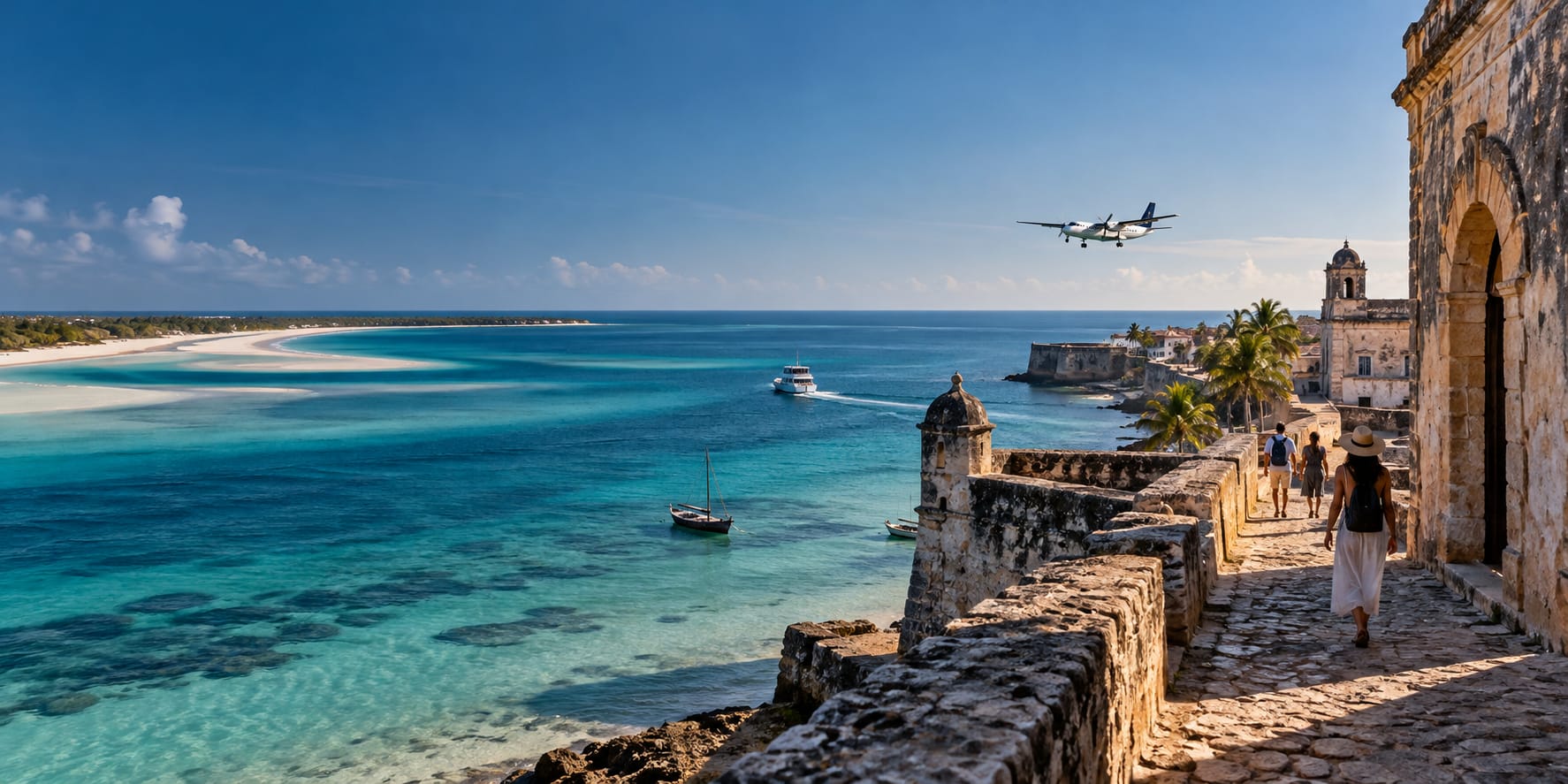
2,500km of coast, a fraction of the revenue
Mozambique has one of Africa's great coastlines: coral reefs, dugongs and whale sharks, island archipelagos, a UNESCO world-heritage island and a rebuilt national park in Gorongosa. Yet tourism earns the country a fraction of what its neighbours make.
The second chance is real. Arrivals are rising, visa barriers have come down, and the country's first tourism summit, held in Vilankulo in late 2025, put the industry back on the policy agenda. This article looks at who visits, where they go, why they spend so little — and what it would take to change that.
Back above a million
Arrivals averaged about 2 million a year in 2016–2019, collapsed to under half a million during the pandemic, and recovered to 1.15 million in 2023, 1.09 million in 2024 and 1.27 million in 2025. Foreign guests in hotels more than tripled between 2020 and 2024 to 757,000, concentrated in Maputo city and province and in Inhambane.
The rebound is real but incomplete: arrivals are still well below their pre-pandemic peak, and the 2024 post-election unrest — with the main South African border repeatedly closed — cost the industry a peak season.
Why a Mozambican visitor spends a tenth of a Tanzanian one
Mozambique earned about $221m (€204m) from international tourists in 2024. Tanzania, with roughly twice the arrivals, earned a record $4.41bn in 2025. Per visitor, that is roughly $200 against more than $1,900.
The difference is the type of visitor. In 2023 a third of Mozambique's arrivals came from South Africa, and in earlier years the share was higher still; many are short-stay, self-drive visitors who bring their own food, fuel and fishing gear. Tanzania sells long-haul safaris and Zanzibar beach packages to Europeans and Americans who pay for flights, parks, lodges and guides.
Mozambique does not have a visitor problem. It has a value problem.
The map of Mozambican tourism
Tourism is concentrated in the south: Maputo, the beaches of Ponta do Ouro and Inhaca, the Inhambane coast around Tofo and Vilankulo, and the Bazaruto archipelago. Gorongosa National Park in the centre has become one of Africa's most celebrated conservation recoveries. The north — Ilha de Moçambique, the Quirimbas archipelago and Niassa — has world-class assets but remains largely off the circuit, partly because of the Cabo Delgado insurgency and limited flights.
Cruise tourism is a small but growing niche: Maputo expected 15 cruise calls and close to 16,000 visitors in the 2026 season, up from nine ships in 2024.
The 2029 targets
The government's 2025–2029 programme aims to lift international tourism revenue from about €204m in 2024 to €361m by 2029, raise tourism's share of GDP from 4% to 6%, and increase tourism employment from about 14,600 to 22,100 workers. Visa exemptions for 29 countries and a new online visa portal are the first steps; the strategy also targets business and events tourism and digital marketing.
Investors have shown interest before: according to the business confederation CTA, tourism attracted more than $1.1bn of investment between 2018 and 2022, making it the third-largest sector for investment.
Five levers to raise revenue per visitor
Air access
Direct, affordable flights from Europe, the Gulf and India to Vilankulo, Pemba and Nampula would bring long-haul, higher-spending visitors.Packages, not just beaches
Combining Gorongosa with Bazaruto, or Kruger with Inhambane, creates the safari-plus-beach product that Tanzania sells so well.Frictionless borders
Fast, predictable crossings at Ressano Garcia and Ponta do Ouro protect the South African market while the long-haul market grows.Security in the north
Ilha de Moçambique and the Quirimbas will only fulfil their potential when Cabo Delgado is stable.Business and events
LNG-driven business travel to Maputo and Pemba can fill hotels midweek and fund better infrastructure for leisure guests.India and the diaspora
India supplied 2.6% of arrivals in 2023. Weddings, heritage tours and business travel from India are an untapped niche.Sources
This report draws on 6 cited sources. View them in Sources cited in every report →
Related insights
 Report
The Quiet Majority: Why Mozambique's Small Firms, Not Its Megaprojects, Will Decide Its Jobs Future
New FinScope data show Mozambique's micro, small and medium enterprises involve 9.3 million people and turn over about 341 billion meticais a month. A critical reading of the numbers — and of a growth model that has bet on megaprojects that employ thousands while small firms carry millions.
 Report
AI Without Industrialisation: Can Africa Leapfrog the Traditional Development Model?
Artificial intelligence promises productivity without factories. We built an original model of job exposure across banking, education, retail, logistics and public administration in Mozambique — and found that the binding constraint is not the algorithm, but electricity, connectivity and paper.
 Report
The Oilseed Corridor: Can Nampula Help Fill India's Cooking-Oil Gap?
On 2 October India's oil industry and the governor of Nampula signed up to explore an oilseed corridor through Nacala. India imports 16 million tonnes of vegetable oil a year; Mozambique sends it almost none. We run the numbers on what the deal could — and could not — achieve.