Water and Watts: Cahora Bassa, Mphanda Nkuwa and Southern Africa's Power Market
Mozambique is southern Africa's hydropower battery — until the Zambezi runs low. A 30% production slump in 2025, a $6–7bn new dam, and the race to connect the 40% of Mozambicans still without electricity.
A battery on the Zambezi
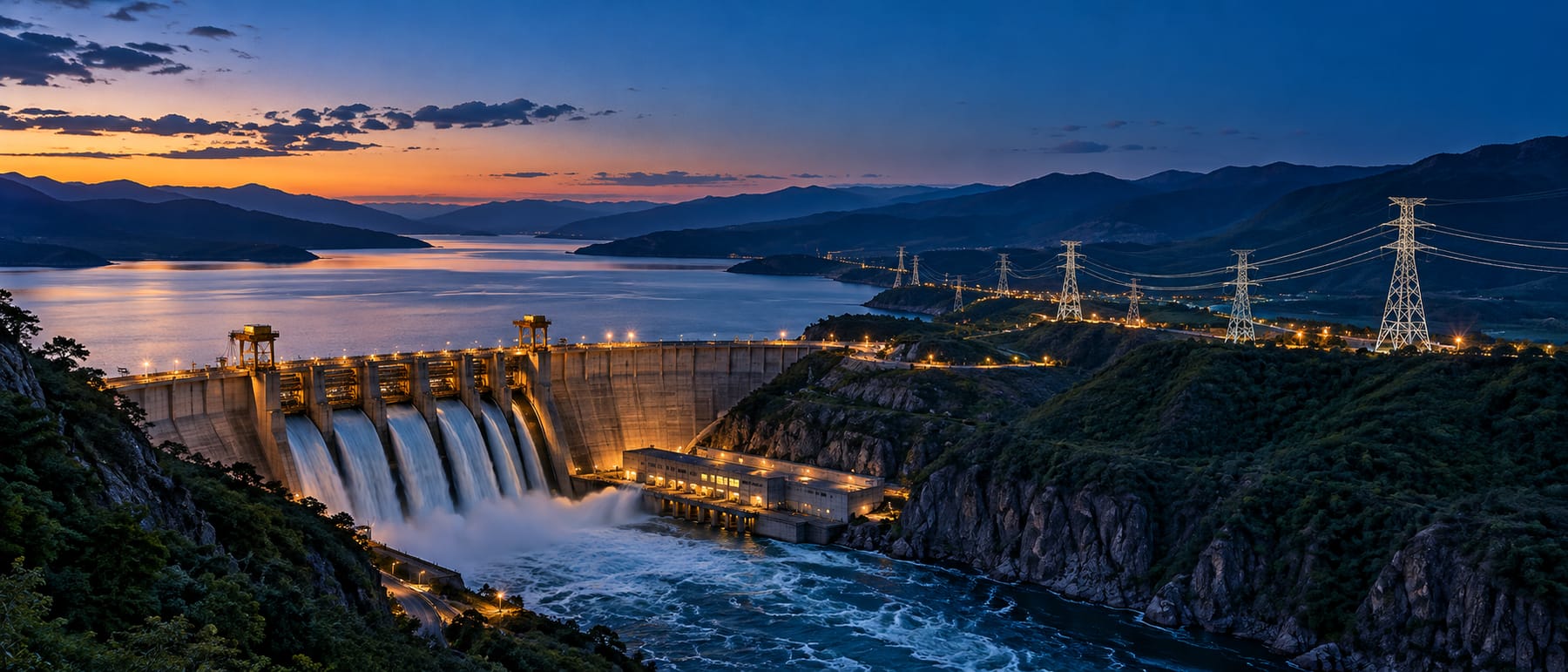
Few countries export electricity on Mozambique's scale. The Cahora Bassa dam on the Zambezi, completed in the mid-1970s, powers South African factories, Zimbabwean homes and, increasingly, Mozambique itself. A second dam downstream, Mphanda Nkuwa, is now in development. Together they make Mozambique a pillar of the Southern African Power Pool.
But the past two years exposed the fragility of an energy system built on one river. This article charts the drought and the recovery, the economics of the new dam and the effort to bring power to the 40% of Mozambicans who still lack it.
The drought year
In 2025 the Zambezi basin suffered what Cahora Bassa's operator, HCB, called one of the most severe droughts in recent decades. Usable storage in the reservoir fell to around 20%, a historic low. Production dropped 30%, from 15,754 GWh in 2024 to 10,921 GWh. Net profit halved to €95.5m, and Mozambique's electricity export earnings fell 34% year on year in the first quarter of 2025, to $104m.
The rains returned. By mid-2026 usable storage had recovered to 56%, and first-half production of 6,399 GWh was 13% higher than a year earlier and about 10% above plan. But the drought had already contributed to the collapse of the Mozal power negotiation, and the lesson stands: a single-river system shares its risk with every customer.
Southern Africa's biggest hydro assets — Kariba, Cahora Bassa and the planned Mphanda Nkuwa — all depend on the same river.
Who buys Cahora Bassa's power
In 2024 two-thirds of HCB's electricity went to South Africa's Eskom (8,319 GWh), 28% to Mozambique's EDM (3,451 GWh) and 4% to Zimbabwe's ZESA (499 GWh). HCB also trades on the Southern African Power Pool markets. Even in the drought year it paid about €256m to the Mozambican state in taxes, fees and dividends — one of the largest single contributions from any company.
That customer mix is changing slowly. As Mozambique's own demand grows with electrification and new industry, more of Cahora Bassa's output will be needed at home — one reason Mphanda Nkuwa and new transmission lines matter.
Mphanda Nkuwa: the $6–7bn second act
Sixty-one kilometres downstream from Cahora Bassa, Mphanda Nkuwa would add 1,500 MW of capacity. In December 2023 a consortium of EDF, TotalEnergies and Sumitomo was selected as strategic partner; in July 2025 EDM and HCB were authorised to take up to 15% each. The concession decree was approved in October 2025.
Updated government figures put the investment at $6–7bn, including a roughly 1,300km high-voltage line from Tete to Maputo that would, for the first time, connect the north-centre's generation directly to the southern load centre. The government expects development to finish by 2028, construction to begin in 2029 and commercial operation from 2034, with 6,000–7,000 construction jobs and about $14bn of public revenue over the project's life.
Lighting up Mozambique
For most Mozambicans the question is not exports but whether the lights come on. Electricity access doubled from 31% in 2018 to 60% at the end of 2024, according to the World Bank, as roughly 9.5 million people gained service. The World Bank-backed ProEnergia programme connected 514,862 households between 2020 and 2024; its successor had added over 340,000 connections by August 2025. EDM plans at least 420,000 new connections by the end of 2026, and the government targets universal access by 2030.
Reaching the last 40% is the hardest part: dispersed rural households, low incomes and long distances. Off-grid solar, mini-grids and results-based finance will have to do much of the work.
What it means for business
- Price in drought risk. Energy-intensive businesses should plan for supply interruptions in dry years and invest in backup and solar.
- Solar and storage are complements, not rivals. Diversifying away from one river is now national policy logic.
- Electrification is a market. Connection works, meters, appliances, pay-as-you-go solar and productive-use equipment grow with every new connection.
- Watch the Tete–Maputo line. It would change where industry can locate in Mozambique.
Sources
This report draws on 8 cited sources. View them in Sources cited in every report →
Related insights
 Report
The Quiet Majority: Why Mozambique's Small Firms, Not Its Megaprojects, Will Decide Its Jobs Future
New FinScope data show Mozambique's micro, small and medium enterprises involve 9.3 million people and turn over about 341 billion meticais a month. A critical reading of the numbers — and of a growth model that has bet on megaprojects that employ thousands while small firms carry millions.
 Report
AI Without Industrialisation: Can Africa Leapfrog the Traditional Development Model?
Artificial intelligence promises productivity without factories. We built an original model of job exposure across banking, education, retail, logistics and public administration in Mozambique — and found that the binding constraint is not the algorithm, but electricity, connectivity and paper.
 Report
The Oilseed Corridor: Can Nampula Help Fill India's Cooking-Oil Gap?
On 2 October India's oil industry and the governor of Nampula signed up to explore an oilseed corridor through Nacala. India imports 16 million tonnes of vegetable oil a year; Mozambique sends it almost none. We run the numbers on what the deal could — and could not — achieve.